

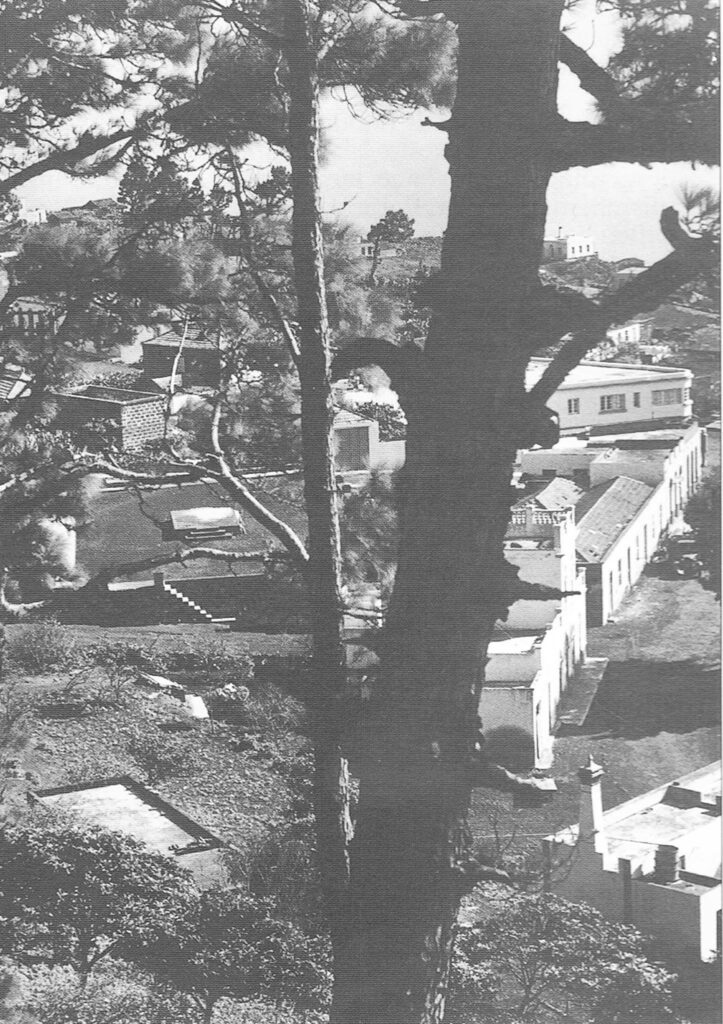
The Town Hall Square of Fuencaliente de La Palma
As is the case in all towns and cities, the square is the nerve center of social life in Fuencaliente de La Palma. A meeting place, for parties and great celebrations, it occupies the site of the old cemetery until its closure in 1925 and had a dirt floor and the layout of a platform that would be completed in the 1960s and later demolished. Since its inception, it has had access from the streets that limit it and for years covered part of a drinking water reservoir, which was later transformed into a space for the exhibition and sale of crafts.
On the adjacent site, the current Town Hall was built, which is the third municipal building in the history of the municipality. Since the mid-1940s, during the time of Mayor Gumersindo Curbelo Yanes, there was interest from the corporation to have a “modest, but decent” building, as stated in the minutes, “we had several times faced the embarrassment, in front of some visitors, of having to conduct our interviews and exchanges of opinions in the street itself, or standing in the narrow and unfurnished room that we had rented.”
On March 24, 1944, the Managing Commission of the Town Hall agreed to commission the project for the new town hall from architect Tomás Machado y Méndez Fernández de Lugo. The harvest that year had been poor, and the council approached the Undersecretary of Labor, Esteban Pérez González, outlining the situation and requesting financial assistance to alleviate unemployment, indicating the construction of the Town Hall as a priority project.
Pérez González, who was also president of the Interministerial Works Board, replied on August 3 of that year, sending a contribution of 100,000 pesetas. The works began on October 29 and were completed on July 18, 1945, with the official inauguration, during the time of Mayor Emilio Quintana Sánchez, celebrated on August 12 of that year. The budget for the work, including the site, amounted to 125,438.60 pesetas. The building, with a square floor plan, consists of the mayor's office, meeting room, secretary's office, general offices, peace court, archives, and sanitary services.
Photo: archive of Juan Carlos Díaz Lorenzo


Related posts


- by Juan Carlos Díaz Lorenzo
- 3 years ago
The Fertile Memory of Pedrín, Countryman and Childhood Friend

- by Juan Carlos Díaz Lorenzo
- 3 years ago
The Steep Slope of the Las Indias Neighborhood

Most Recent
👁️ 459 
👁️ 3,392 
👁️ 20,128 