


Those Trips on the Ships “Ciudad de Huesca” and “Ciudad de Teruel”
From the late sixties and for just over a decade, during which the ships “Ciudad de Huesca” and “Ciudad de Teruel” were in service, the crossing between the ports of Santa Cruz de Tenerife and Santa Cruz de La Palma took ten hours to cover the distance of 108 nautical miles that separates both capitals.
Ten hours in good weather, of course, because when winter storms came, the journey often took a bit longer. However, those elegantly designed ships were the favorites of the people from La Palma compared to the uncomfortable “santas,” which moved so much that the trip seemed endless.
In the mid-seventies, when Spain was experiencing the end of the dictatorship and the convulsions of the democratic transition, the ship was the option chosen by most passengers who, short on money, opted for this means, as the plane was not only more expensive but also had a limited number of seats and flights. At that time, the ticket price on the ship ranged from 75 pesetas for third-class economy to 96 pesetas for special third class.
Tickets were purchased at Casa Cabrera, which then had the appearance of an English office, located on the ground floor of the emblematic building on Real Street in the capital of La Palma, and in the capital of Tenerife, at the AUCONA offices, on the mezzanine of the first floor of the building on La Marina Street, on the same site where the main headquarters of BBVA currently stands.
The ships alternated weekly on the Tenerife-La Palma-Gran Canaria and Gran Canaria-Fuerteventura-Lanzarote routes, so that, if it was not strictly necessary, there were passengers who preferred the service of these ships instead of the “santas,” whose third class, in the first three of the series, formed by a seating area, quickly turned into a collective seasickness room. At the stern, while the sailors attended to the departure maneuver, passengers crowded together, engaged in lively conversation before the cold and the change in weather upon rounding the Anaga cliffs advised them to gather inside. While the stern bar remained open, the most persistent held on between drinks until there was no choice but to look for their assigned bunk.
For those who had managed to get a ticket in the special third class, located at the stern, the journey could have a bit more intimacy, as there were quadruple and double cabins available. Fatigue allowed for a few hours of sleep, despite the constant noise of the propeller shaft, located just beneath our feet.
The scene was quite different in third-class economy. A barrack-style dormitory, located right next to the bow cargo hold bulkhead, formed by a pile of bunks, was the available accommodation. Soon seasickness began, which ended up affecting all passengers, and the penetrating smell of humanity and the loud snores of some mercilessly took over the suffering passengers sharing the space.
Before dawn, when the clock indicated that arrival in La Palma was near, the younger passengers and those who simply could not stand being in a closed space any longer after the night they had experienced, would go out on deck and lean against the railing to watch the approach to the port of La Palma. The chronicler remembers perfectly those trips where he shared a moment of conversation and learned nautical knowledge during the watch of the officers Enrique San Antonio —who tragically passed away years later in a traffic accident in Las Palmas— and Lorenzo Suárez Alonso.
Lorenzo Suárez Alonso —an excellent professional and endearing person, who later became one of the first captains of the emblematic jet-foil, later mayor of Candelaria, a prominent politician in the Government of the Canary Islands, and delegate of Trasmediterránea in the Canary Islands until his retirement— boarded for the first time in November 1971 on the ship “Ciudad de Teruel,” a few days after the eruption of the Teneguía volcano began. The ship was then commanded by Captain Ramón Font Albert, a Valencian, good technician and better person, who would later command the ship “Ciudad de Granada.”
Among the captains who commanded these ships, we remember Cecilio Montañez Reguera —later captain of the ships “Isla de Menorca,” “Ciudad de Santa Cruz de La Palma,” “Ciudad de La Laguna,” and “Villa de Agaete,” as well as of the “vientos” series—, Ramón Postigo Santana, Gabriel Blanco Galdín, Joaquín Echagüe —belonging to the group of “africanists,” due to the years he spent on the Guinea line aboard the historic “Dómine”—, Luis Segarra Badillo, Tomás Ravelo García, and Antonio Díaz-Llanos González, who would later become captain of the “dolphins” and the emblematic “Juan J. Sister.”
With the anchor hanging and the bosun on the castle awaiting the order signaled from the bridge —“drop!”—, the ship maneuvered with the help of the pilot of the time, the unforgettable Captain José Amaro Carrillo González-Regalado, a portuense who fell in love with La Palma in his youth and decided to spend the rest of his life in the capital of La Palma. When the sailors threw the ropes to shore and they were secured to the bollards, and the hull gently brushed against the fenders of the dock, it was time to put the gangway in place, located next to the hatch of the stern cargo hold, marking the end of the journey.
At the dock, family and friends awaited to receive the newcomers. It was common to see Peugeot 403 and Peugeot 404 taxis, either sedan or station wagon —as those who had come from Venezuela said—, taking advantage of the trip to carry several passengers and their luggage in the trunk.
Other passengers were picked up by their parents or relatives to take them in their cars, mostly models manufactured in England —Austin, Morris, Ford, and the more modern Hillman, Sunbeam…— and national ones, including the first SEAT 600, 850, and 124, and only a few, especially during holidays, could afford the luxury of bringing their own cars in the hold or on the deck of the ship —both due to cost and limited space—, being loaded through the ship's supports. All this changed after 1979 when the ferries “Ciudad de La Laguna” and “Villa de Agaete” arrived in La Palma.
Those passengers who had no means of transportation or were not expected by anyone rushed to catch the “correo” on the waterfront in Avenida Marítima, at the stop located at the corner with Apurón Street, or a little further on, at the northern buses, those going to that part of the island, eager before any distraction could make them miss the trip.
Suitcases, boxes, and other bundles were loaded onto the roofs of the buses that had wooden bodies, thus managing to reach their destinations. Others took advantage of the return trips of the fruit trucks —which included brands like Pegaso, Commer, Berliet…—, which had loaded their precious cargo of bananas in the valleys of Aridane, Fuencaliente, Tijarafe, and Los Sauces. The truck drivers we remember were generous people who tried to help their fellow countrymen and acquaintances. All of this is now history from a past that is becoming more distant every day.
Photo: Nicolás Arocha for puentedemando.com


Related posts
👁️ 4,414 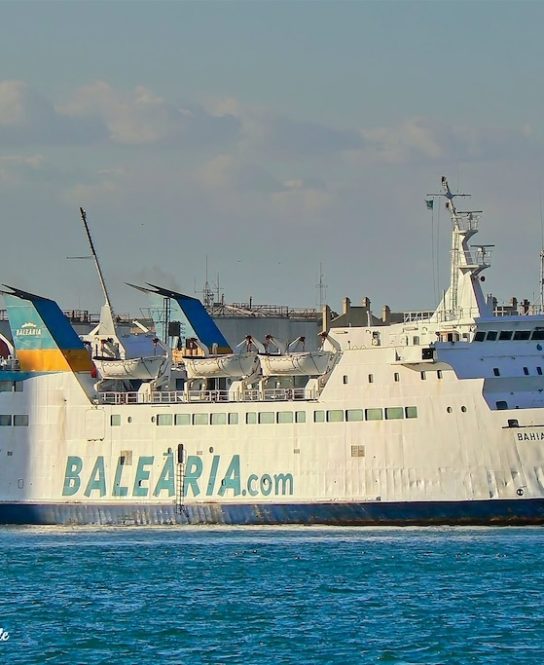

- by Juan Carlos Díaz Lorenzo
- 4 days ago
The ferry “Don Cándido”, formerly “Bahía de Málaga”, arrives at the scrapyard after 46 years of maritime life


Most Recent
👁️ 1,075 
👁️ 2,577 
👁️ 17,786 