


The Steamship “Gomera” (1912-1965)
On March 27, 2016, 105 years had passed since the announcement of the competition by which the Spanish state opened the legal period for national shipping companies interested in submitting their bids for the regular service of the Canary Archipelago and the neighboring African coast. This competition was of particular importance because, among other reasons, it opened a new and significant stage in the history of maritime transport in the Canary Islands.
The terms of the contract required the successful bidder to possess three ships of 1,100 tons displacement and another three of 550 tons, with the aim of carrying out six monthly expeditions to the ports of the main itinerary and another six expeditions to secondary ports, as well as one monthly expedition to the colony of Río de Oro.
The awarded company was the Interinsular Canary Mail Steamship Company, a subsidiary of the British company Elder & Dempster, which had been providing this service since 1888. To meet the contract conditions, the aforementioned Interinsular Canary Mail Steamship Company ordered the construction of six mixed cargo and passenger ships at British shipyards, of which the three largest were named León y Castillo, Viera y Clavijo and La Palma; and the three smaller ones, popularly called “beach boats,” were named Gomera-Hierro, Lanzarote and Fuerteventura.
The first of them was named Gomera-Hierro and was built at the Dundee factory of Caledon Shipbuilding & Engineering Co. Ltd. (England), with the yard number 225. On January 22, 1912, it was launched with the customary ceremony, and on March 8 of the same year, it was delivered to its owning company, making the journey to the port of Las Palmas, which it reached eight days later alongside the steamship León y Castillo, amidst great anticipation. Subsequently, both ships were beached at the facilities of the Grand Canary Slipway & Engineering Co. for painting their hulls.
On April 1, the steamship Gomera-Hierro arrived for the first time at the port of Santa Cruz de Tenerife, coming from the previous port, and that same day it was dispatched to Porís de Abona, El Médano, Los Abrigos, Los Cristianos, Adeje, Guía de Isora, Vallehermoso, and Valle Gran Rey.
With a riveted steel hull and a single deck, it was a ship of 484 gross tons, 259 net tons, and 890 tons displacement at maximum load, with dimensions of 50.95 m overall length - 48.86 m length between perpendiculars - 7.92 m beam, 5.56 m depth, and 3.35 m maximum draft. It had two holds, located at the bow and stern of the central superstructure, with a cubic capacity of 343 cubic meters for grain and 318 cubic meters for bales, and the tween decks, with a capacity for 183 cubic meters of grain and 165 cubic meters of bales. The main hatch measured 3.60 x 3.30 m and was assisted by a three-ton hoist.

Accommodation plan of the steamship "Gomera"
The propulsion system consisted of a triple expansion steam engine, manufactured in the shipyard's workshops, with a nominal power of 100 horsepower, which drove a shaft and a propeller allowing it to reach a speed of 11 knots in good weather. A Scottish return-flame boiler generated the necessary steam, with a pressure of 180 pounds per square inch. The grate area was 5.30 square meters and the heating surface was 182.46 square meters. It consumed coal at a rate of 11 tons per journey. The coal bunkers had a capacity of 118 tons, and the ballast tanks could store 116 tons and the distilled water tanks, 30 tons.
The accommodation for passengers consisted of several first and second-class cabins, and a third-class saloon at the stern, with a total capacity for 49 passengers.
Thus began the seafaring life of this ship in the waters of the Canaries, where it shared journeys with its fellow ships. In September 1919, it brought from Las Palmas to the port of Santa Cruz de Tenerife the equipment to begin the refloating of the steamship Westburn, sunk in the waters of Anaga.
Year after year, it connected the islands in its mission as a mail ship, until in 1929, after the acquisition of the Yugoslav steamship Vojvodina, which was renamed Hierro, the steamship Gomera-Hierro was renamed simply Gomera.
In early 1930, Emilio Ley Arata, head of the Elder House in the Canaries and director of the company, and Juan March, following the government's instructions, negotiated the transfer of the maritime service concession to the Trasmediterránea Company. In June, the absorption of the Interinsular Canary Mail Steamship Company was definitively resolved, with Trasmediterránea taking over the possessions and facilities that the Company had in all the Canary ports and on the African coast, the fleet of ships, and the personnel.
From then on, the steamship Gomera sailed under the flag of Trasmediterránea. On July 18, 1936, like the rest of the inter-island fleet, the steamship Gomera was militarized by the national navy authorities and remained in the waters of the Archipelago and the Sahara throughout the conflict. In April 1939, when its militarization ended, it continued to provide inter-island services in the Canaries and links with the African coast without any significant incidents to report.
In 1942, the steamship Gomera was in the waters of the Gulf of Guinea, covering the service between the ports of Fernando Poo and Bata. At that time, the gunboat Calvo Sotelo was also stationed at the naval base. On the night of January 14 of that year, the city of Santa Isabel, capital of the island of Fernando Poo and the Spanish territories in the Gulf of Guinea, was startled by a series of explosions carried out by an English commando that cut the moorings of the ships Duchesa de Aosta, Likomba and Bibundi, interned since 1940. They managed to take them out of the port, and in just half an hour, they had written one of the most cunning pages of World War II in Spanish waters.
Back in the waters of the Canaries, in 1950, it went to the aid of the Italian merchant ship Lauzano, which had run aground on the African coast between Cabo Blanco and Villa Cisneros and rescued several of its crew members. And in 1951, it boarded the motor sailboat Bella Lucía, when it was sailing on the route to Fuerteventura.
In 1965, it suffered a serious incident that ultimately led to the end of its seafaring life after 53 years of service. On the night of January 19, during one of its regular trips between Las Palmas, Lanzarote, La Güera, and Port Etienne, it ran aground on a sandbank about eight miles south of El Aaiún. The situation became truly distressing, and its distress call was picked up by the Coastal Station. The motor vessel Ciudad de Teruel and the fishing boat Juan y Matilde came to its aid, with the latter being the first to arrive at the scene of the accident, although it could not approach the stranded ship as it remained with its lights off due to a failure in the electrical system. At dawn, the mentioned fishing boat was able to approach and transferred the 17 passengers on board without any incidents reported.
Initially, there was pessimism regarding the refloating of the Gomera, but with the help of the tugboat Pacific, which set sail from the Gran Canaria port, the steamship Gomera was able to be refloated, with some leaks and a break in the main boiler check joint being noted, a situation in which it was able to return to Las Palmas, where it arrived at dawn on January 21.
The repair of the ship was deemed unfeasible, which is why the Board of Directors of Trasmediterránea Company agreed to its sale, being removed from the maritime communications sovereignty contract and officially decommissioned by order of April 27, 1965. In September, it was sold for scrap to the scrapper J. Castillo in Barcelona, becoming the first of the black inter-island vessels to leave the sea forever.
Photos: Archive Juan Carlos Díaz Lorenzo, Manuel Rodríguez Barrientos and Laureano García Fuentes
Bibliography
Díaz Lorenzo, Juan Carlos. One Hundred Years of Interinsular Canary Steamships. Santa Cruz de Tenerife, 1989.
Díaz Lorenzo, Juan Carlos. Sheltered from Anaga. Two volumes. From the Inter-Island Vessels to the Fast Ferry (vol. I) and From the Sea and the Ships (vol. II). Madrid, 2004.


Related posts


- by Juan Carlos Díaz Lorenzo
- 3 years ago
“Villa de Bilbao” (1962-1981), naval registration of Valencia
- by Juan Carlos Díaz Lorenzo
- 3 years ago
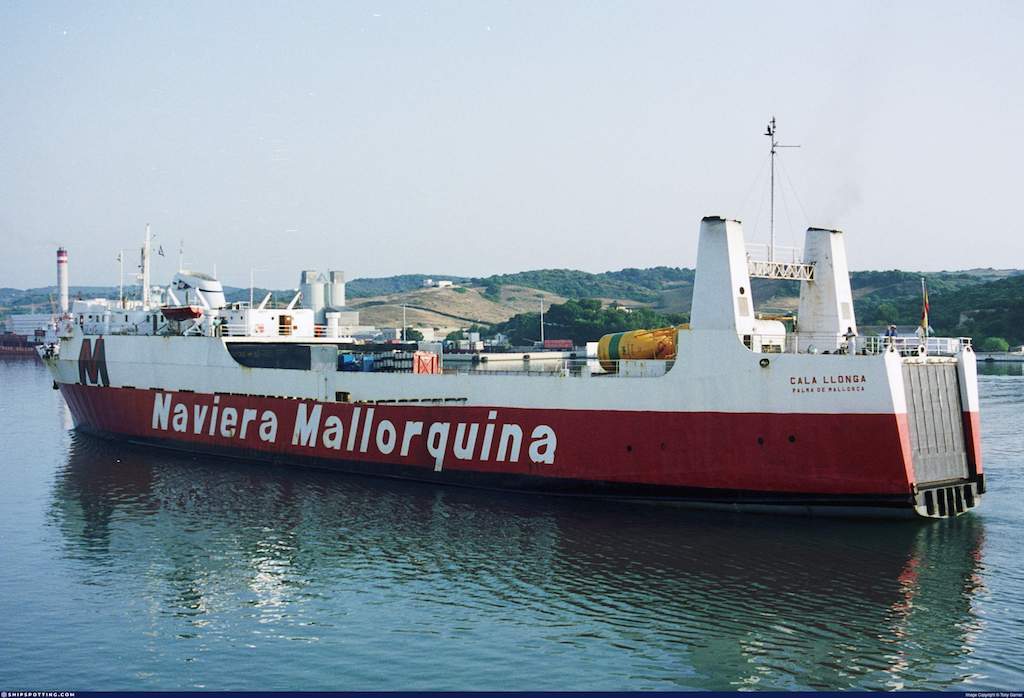
The Maritime Life of the Roll-on Ship “Cala Llonga” (1972-1999)
👁️ 235 
- by Juan Carlos Díaz Lorenzo
- 3 years ago
The iconic ferry “Juan J. Sister” celebrates thirty years
Most Recent
👁️ 1,077 
👁️ 2,579 
👁️ 17,801 