


The Cabotage Ship “Llumeres”, Naval Registration of Gijón
The ship “Llumeres”, registered in the naval registry of Gijón, belongs to the history of cabotage in the Cantabrian Sea and the Canary Islands. Recently, we learned about the mining site from which it takes its name on the Asturian coast. In the 19th century, the Gozón Mining Company began extracting iron ore from several mines in the area, including Llumeres, which was later taken over by Duro Felguera. Antón Saavedra explains this in detail and with precision in his interesting article titled “Llumeres, a story of iron and sea”.
This company, deeply rooted in the industrial history of Asturias, built a small port near the mine and other facilities, of which only ruins remain today, and shipped the ore to Gijón, from where it was mostly exported to England, while the rest was sent to the La Felguera factory for processing in the blast furnaces. In 1919, an aerial cable was built for transport to the El Regueral station, about seven kilometers away, which belonged to the Carreño Railway, from where it was transported by train to La Felguera.
Duro Felguera expanded and modernized the mining facility with a vertical shaft equipped with a headframe, and as part of its social policy, ordered the construction of a block of housing for its workers near the beach of Bañugues – which we also had the opportunity to visit – a neighborhood known since its opening in 1962 as Cases de la Mina. The Llumeres deposit was closed in 1967, due to both the depletion of the ore and the technical difficulties involved in its exploitation.
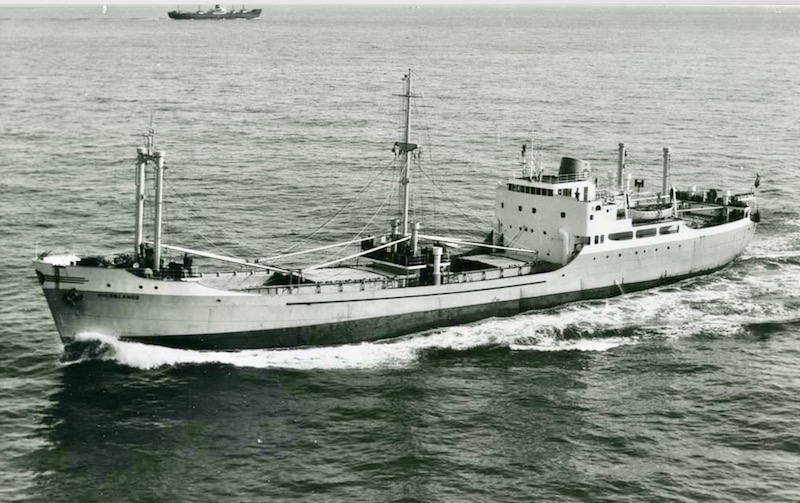
As for the ship “Llumeres”, built with a riveted steel hull, it took shape at El Dique, as the shipyard of the Duro Felguera Metallurgical Society was known, in Gijón. Launched in November 1943, it was delivered in April 1944 and set sail with the marks of neutrality painted on its side, as it was during World War II. In October 1947, it passed into the ownership of shipowner Juan Varela Álvarez and twenty years later to the ownership of the Varela Hermanos company, also based in the aforementioned Asturian port.
In the Canary Islands, it was present several times in the 1950s and 1960s, being consigned at the port of Tenerife by Convasca, whose headquarters were on San Francisco Street. Jerónimo Rodríguez Rosales recalls the trip he took aboard with his father as a child, on the occasion of the Bajada de la Virgen de las Nieves in 1950. We remember seeing it docked at the riverside dock of the port of Santa Cruz de Tenerife, which was its base for regular traffic with La Palma and Gran Canaria, where it featured a high bridge for better visibility due to the volume of cargo, such as the poles for tomato growers that it loaded in Garafía and Puerto Espíndola, on the coast of San Andrés and Sauces.
It then returned to the Cantabrian Sea and in 1979 it was listed as the property of Alberto Aizpurúa Odriozola. In 1990, we saw it painted green and converted into a dredger in the port of Barcelona, and then we felt the emotion of the years gone by when we read its name again on the starboard side. Jordi Montoro keeps the news published in March 1999 in the newspaper "Marítimas", in which the ship ended up sinking while docked at the attached pier, a day after a leak signaled the end of its long maritime life.
With a gross tonnage of 275 tons, a net tonnage of 171 tons, and a deadweight of 320 tons, it measured 35.45 m in overall length – 32.50 m between perpendiculars, 8 m in beam, 3 m in depth, and 2.74 m in maximum draft. It was powered by a semi-diesel engine of 210 horsepower, which allowed it to maintain a speed of 8 knots when new and in good weather. IMO Code 5210040.

News published in the newspaper "Marítimas" of Barcelona

News confirming the sinking of the ship "Llumeres"

The cabotage ship "Llumeres", viewed from the starboard side

Remains of the Llumeres mining facilities
Photos: archive of Jerónimo Rodríguez Rosales, Alberto Mantilla and Juan Carlos Díaz Lorenzo
Tags


Related posts


- by Juan Carlos Díaz Lorenzo
- 3 years ago
A Pescanova Project for Cuba Built in Mallorca
- by Juan Carlos Díaz Lorenzo
- 3 years ago
The Ship “Picoblanco” (1958-1981), Naval Registration of Bilbao

- by Juan Carlos Díaz Lorenzo
- 3 years ago
The Tanker Ship “Galdácano” (1961-1985), “the Acid Ship”
Most Recent
👁️ 4,134 
👁️ 5,516 
👁️ 4,884 