


The ship “Candelaria B”, formerly “Guadalquivir”, formerly “Lago Enol”
The last ship built on behalf of Naviera Lagos was named “Lago Enol” and took shape at Astilleros del Atlántico, Santander, a shipyard controlled in its shareholding by the Pérez-Maura family, who were also shareholders of Naviera Pinillos, along with brothers Alberto and José Herrera Hernández, among others. The subsequent vicissitudes meant that this ship was the penultimate newly built vessel to fly the flag of the then centenary shipping company.
Construction number 217 of the aforementioned shipyard, on October 14, 1982, the keel was laid, and on April 26, 1983, it slid down the slipway. Almost six months later, on October 17, 1983, the official delivery took place after verifying the sea trials, in which it reached a speed of 16.5 knots. José Antonio Asenjo was its first captain, and the new ship debuted on the Canary Islands-Sevilla route.
At that time, it was a ship of 4,093 gross tons, 1,805 net tons, and 3,736 deadweight tons, with main dimensions of 96.14 m in overall length – 86 m in length between perpendiculars – 17.43 m in beam, and 6.25 m in draft. It was powered by a Burmeister & Wain 6L45GFCA engine – manufactured under license at AESA workshops in Sestao – with a power of 5,910 horsepower on a shaft, allowing it to maintain a speed of 15 knots.
In February 1986, the General Directorate of Merchant Marine authorized the renaming of this ship to “Guadalquivir”, with a ceremony held on November 3 in the port of Sevilla, attended by various authorities, including the then president of the Junta de Andalucía, José Rodríguez de la Borbolla, and the president of the Cabildo Insula de Tenerife, José Segura Clavell. At that time, Alberto Herrera Hernández was president of Naviera Pinillos, and his brother José was vice president, with the board also including José Nelson Ruano, Luis Esteban Marcos, Manuel Librero Granados, and Alejandro Lamagniere. At that date, the ship “Guadalquivir” was under the command of Captain José María Arróniz Dabán.[1]
In a brief speech, Rodríguez de la Borbolla celebrated Naviera Pinillos' decision to name its most modern ship after the Guadalquivir River, linked since its commissioning to the port of Sevilla, where it made a weekly rotation. Alberto Herrera thanked the president of the Junta de Andalucía for his words of recognition and gratitude and justified the act as a response to Naviera Pinillos' tradition of naming all its ships after rivers in the national geography, backed by a feeling of brotherhood and cordiality with the Sevillian port, with which the shipping company had maintained service for many years.
On January 13, 1989, with considerable delay from the expected dates, the ship “Guadalquivir” was beached at ASTICAN to carry out cutting and lengthening work on the hull with the addition of a new section of 14.95 m in length, in a contract signed by the presidents of Naviera Pinillos, Alberto Herrera, and Astilleros Canarios, Carlos Padrón, for an amount of 260 million pesetas, financed by the Banco de Crédito Industrial.
This work added an additional capacity of 60 TEUs, and during its stay at ASTICAN, two fires occurred, the first on January 31 and the second on February 9, causing varying degrees of damage. On May 19, it was floated again, and on the 31st, it went out for trials, continuing afterwards to Astilleros Luzuriaga, where it remained for 30 days, departing on August 5 for Santa Cruz de Tenerife to rejoin the Sevilla route. From then on, the ship “Guadalquivir” registered 5,021 gross tons, 2,381 net tons, and 4,844 deadweight tons, with a hull of 111.64 m in overall length and 100.95 m in length between perpendiculars.
In 1998, a few months after the Boluda Group had purchased Naviera Pinillos, the ship “Guadalquivir” was renamed “Candelaria B”, in homage to the Patroness of the Canary Islands, Our Lady of Candelaria, whose feast is celebrated on February 2 and August 15 at the basilica of the Marian town of Candelaria. For six years, it remained in the Canary Islands traffic – a stage in which it was painted blue and flew the flag of the Valencian group – until its sale in 2004, being renamed “Sicilia Breeze”.
In its last stage, it bore the name “Saint Andreas” and was listed as owned by the Greek company Sea Velvet International S.A., flagged in Saint Vincent & Grenadies. It was detained several times for deficiencies and was finally sold for scrap in October 2012 and dismantled in Aliaga (Turkey).
Photo: Juan Carlos Díaz Lorenzo
Note:
[1] Díaz Lorenzo, Juan Carlos (1991). Naviera Pinillos 1840-1990. 150 years of maritime history. pp. 161-162. Santa Cruz de Tenerife.
Tags


Related posts
👁️ 3,261 

- by Juan Carlos Díaz Lorenzo
- 5 days ago
"Al Andalus Express", a veteran "train ferry" of the English Channel on the inter-island routes of the Canary Islands
👁️ 4,700 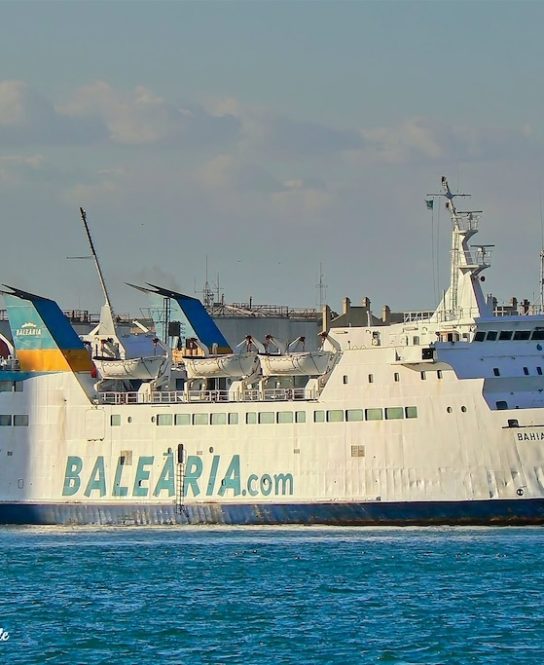
- by Juan Carlos Díaz Lorenzo
- 2 weeks ago
The ferry “Don Cándido”, formerly “Bahía de Málaga”, arrives at the scrapyard after 46 years of maritime life
👁️ 395 

Most Recent
👁️ 3,828 
👁️ 5,154 
👁️ 4,568 