


The Seafaring Life of the Ship “Andrés Rial” (1947-1967)
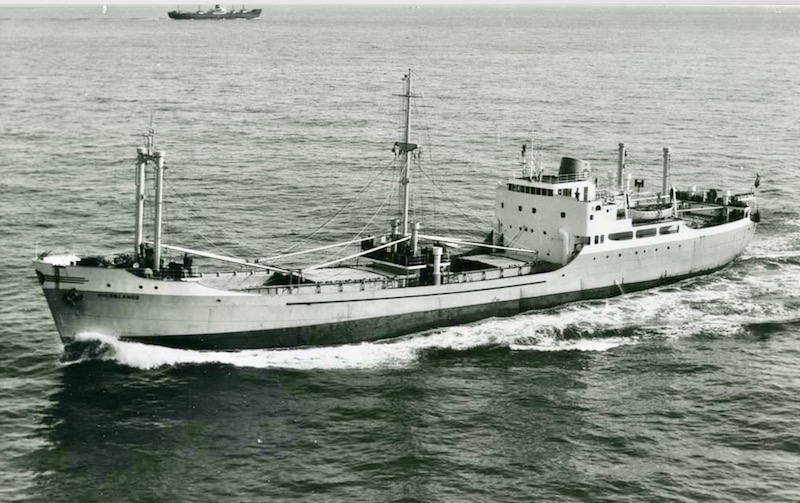
In December 1959, the Lanzarote shipowner Antonio Armas Curbelo (1899-1985) purchased the ship “Andrés Rial”, which until then had been owned by the Galician shipowner Luis Rial Paz since its commissioning. The incorporation of this vessel solidified his foothold in coastal shipping, which at that time already included the motor vessels “Concepción Aparisi” and “Rosita Soler”, as well as several motor sailboats.
This circumstance also marked a milestone in its trajectory, as it allowed him to increase his presence in the sector and also made long-distance voyages, the first of which took place in February 1960. In the port of Santa Cruz de Tenerife, it loaded a full cargo of bananas for Malta and then, in ballast, proceeded to Torre Annunziata, Italy, where it loaded staves destined for Seville and peat in Huelva for the Tenerife port. The second voyage also carried bananas for Malta and then continued to Bona (Algeria), where it loaded phosphates for Huelva.
In March 1966, it entered the port of Casablanca to disembark eleven shipwrecked sailors and one deceased member of the crew of the fishing steamer “Pochola”, based in Cádiz. On the morning of the 11th of that month, while the ship “Andrés Rial” –captained by Cándido Borges Álamo, 32 years old– was sailing about 40 miles from Casablanca, they observed on their port side the presence of a ship from which distress flares were being launched. When they reached the vicinity, the captain of the fishing vessel reported that there had been an explosion in the engine room, and after rescuing its crew and evacuating the body, a 150-meter towline was given. After a journey of 28 miles, it was noted that the fishing vessel was sinking by the stern, so the towline was cut. Upon arrival at the aforementioned Moroccan port, they were placed under the custody of the Spanish consul in that city.[1]
On January 13, 1967, the ship “Andrés Rial” left the port of La Luz in Las Palmas de Gran Canaria on a voyage to El Aaiún with general cargo and construction materials. When sailing about 25 miles southeast of Gran Canaria, the crew noticed that the ship was listing and had difficulties maintaining an upright position. Upon uncovering the hatch of the hold, it was found to be flooded, and the captain, Cándido Borges Álamo, faced with the gravity of the situation, opted to turn back and return to the port of departure, informing his shipowner and the Maritime Command of the situation.[2]
Assistance came from the tugboat “Tamarán” and the ships “Puerto de Burriana” and “Puerto de Denia”, also from Antonio Armas Curbelo's fleet. When they were one mile southeast of the port of Las Palmas, the eleven crew members of the “Andrés Rial” had to abandon the ship due to the imminent danger of sinking, which indeed occurred at 15:25 hours that day, when it was located at 28º 04’ N and 20º 04’ W.
The construction contract number 17 with Astilleros y Talleres del Noroeste (ASTANO) was signed on November 19, 1943. The keel was laid on May 10, 1944, and its completion took no less than three years due to the difficulties at that time in supplying materials. Thus, launched on May 23, 1947, it underwent sea trials on June 28 and was delivered to the aforementioned Galician shipowner on August 1.
With a riveted steel hull, it had a gross tonnage of 398 tons, a net tonnage of 232 tons, and a deadweight of 500 tons, with a total length of 44.80 m - 40.80 m between perpendiculars - a beam of 8 m, a depth of 3.45 m, and a draft of 2.44 m. It was powered by a Krupp engine, with 500 horsepower, allowing it to maintain a speed of 10 knots. The final cost amounted to 2,200,000 pesetas, and it was registered in the naval registry of Ceuta.
Since its commissioning, the ship “Andrés Rial” sailed in national coastal traffic and made some trips to European ports, dedicated to “tramping”. The most serious incident suffered during the twelve years of its first stage occurred on April 6, 1959, when it collided in the port of Seville with the German ship “Hildegard Peters”.
José Ramón Varela, author of the website of the ships of Corme (jrvarela.net), notes that this ship was very well known in the mentioned locality, for “a peculiarity worth mentioning: Its crew was selected, not for their seafaring experience, but for their choral qualities. A ship where all its crew members were good singers. In the galley, they had a collection of guitars of different sizes. They even gave a concert in a theater in Gijón. It is also remembered that when they were docked in Seville, they were visited by Juanita Reina, who sang with them.”
He adds that “this ship was very popular in its time, not only for its dual aspect of sailors and musicians but also because it was the one where the most was earned. In the 1940s, sailors were paid up to 3,000 pesetas. A sailor on this ship earned more than many captains on other ships.” And, moreover, it seems that “it had a reputation for being a ship that engaged in a lot of smuggling.”
Bibliography:
Díaz Lorenzo, Juan Carlos (2004). “Naviera Armas. A new generation”. p. 172. Las Palmas de Gran Canaria.
Fene.com
Jrvarela.net
Notes:
[1] La Vanguardia, March 18, 1966.
[2] Diario de Las Palmas, January 13, 1967.
Photo: Fene.com


Related posts


- by Juan Carlos Díaz Lorenzo
- 3 years ago
A Pescanova Project for Cuba Built in Mallorca
- by Juan Carlos Díaz Lorenzo
- 3 years ago
The Ship “Picoblanco” (1958-1981), Naval Registration of Bilbao

- by Juan Carlos Díaz Lorenzo
- 3 years ago
The Tanker Ship “Galdácano” (1961-1985), “the Acid Ship”
Most Recent
👁️ 1,075 
👁️ 2,576 
👁️ 17,781 