

Ten Years Connecting the Bay of Cádiz: An Efficient Service
On June 10, the maritime service of the Metropolitan Transport Consortium of the Bay of Cádiz will celebrate its tenth anniversary. A decade in which four vessels that are part of the maritime landscape have established and consolidated a pioneering transport system in Andalusia, taking advantage of the geographical nature of the Cádiz bay, which has a special charm.
The project came to fruition after several attempts by private initiatives, among which we recall the ship "Adriano Tercero," made of wood, very popular in the area, which connected Cádiz and El Puerto de Santa María, and before that, the tugboat "Matagorda," which transported personnel from the shipyard of the same name. Until the moment when the Metropolitan Transport Consortium of the Bay of Cádiz decided to launch it, connecting Cádiz with the towns of Rota and El Puerto de Santa María, through the organization of two regular lines in an efficient and modern service, with departures all year round.
There we had the opportunity to meet José Luis Fernández Rioja, a naval technician and head of the vessel service, and Captain Eduardo Bianchi García de Polavieja, who has been working in this company for almost ten years. On our trip to Rota, the chief engineer Salvador Bohórquez Sánchez and sailor José Miguel López Corrales were on duty. It is noteworthy that the nautical management is handled by the Suardíaz Group, one of the most reputable in our country.

Captain Eduardo Bianchi and naval technician José Luis Fernández

Captain Eduardo Bianchi García de Polavieja, chief engineer Salvador Bohórquez Sánchez, and sailor José Miguel López Corrales
The road distances separating both towns from the capital of Cádiz are approximately 47 kilometers in the case of Rota and 20 kilometers to El Puerto de Santa María. By sea, it is reduced to 6.5 and 5 nautical miles, with a travel time of 35 minutes to Rota and 30 minutes to El Puerto de Santa María, respectively.
In the winter season, the Cádiz-El Puerto de Santa María line offers 33 departures from Monday to Friday, of which 17 correspond to the outbound journey and 16 on the return; 12 departures on Saturdays (six in each direction) and 10 departures on Sundays and holidays (five in each direction).
In summer, the schedule increases to 30 departures on Saturdays and holidays (14 towards El Puerto de Santa María and 16 towards Cádiz). On the Rota line, there are 15 departures from Monday to Friday (seven towards Cádiz and eight towards Rota) and six departures on Saturdays and holidays, which increase in summer to 13 departures (six towards Rota and seven towards Cádiz).
The months of July and August also offer a night service on Fridays and Saturdays, with the last departure at 1:30 AM, making for a very pleasant stroll through the Cádiz bay. It is also reinforced during carnival days, where the offer increases by 176% over the usual capacity.

The capital of Cádiz at dusk

Upper deck and command cabin
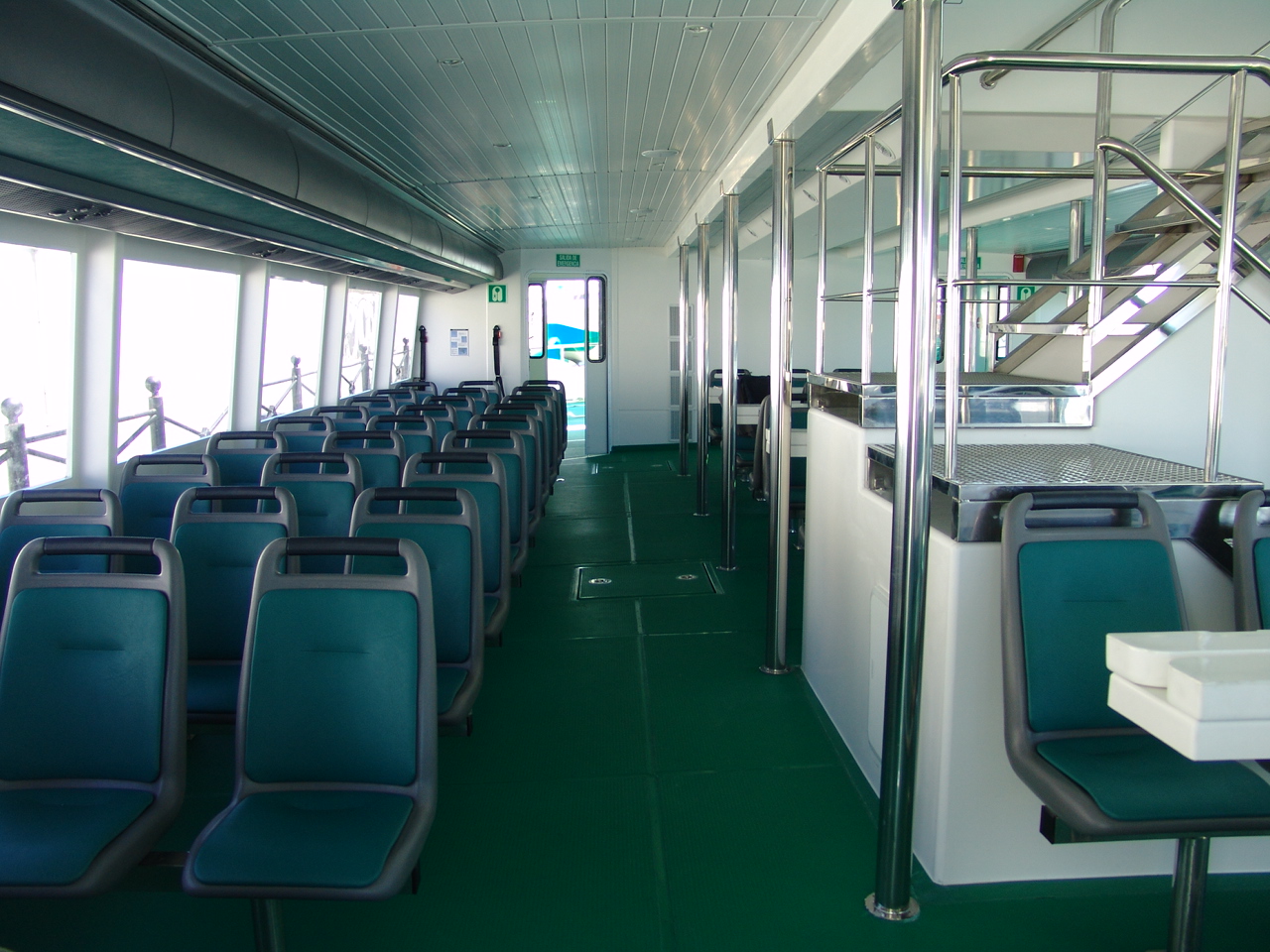
Upper deck of the ship "Bahía de Cádiz Cuatro"
The maritime service of the Bay of Cádiz has an important advantage as it directly connects the urban centers of the three towns, allowing free parking in the parking lots of El Puerto de Santa María and Rota if the passenger uses the catamaran. In the port of the Cádiz capital, the docking is at the Reina Victoria dock, making it as close and well-located as possible. Additionally, it offers a free bike rental service at each terminal.
The service is integrated into a unique fare system, and with a prepaid card, tickets can be purchased on this and any other transport system belonging to the network of the Ministry of Development of Andalusia. It has a discount of up to 10% on card recharges. The regular ticket for the Cádiz-El Puerto de Santa María line is €2.65 and €5.05 for the Cádiz-Rota line, with large families also benefiting.
Since its inauguration almost ten years ago, the maritime service of the Metropolitan Transport Consortium of the Bay of Cádiz has transported just over four million passengers. The annual average of the two lines is around 420,000 users, and the trend continues to rise. We have been able to confirm that it is a very popular means of transport in the area and has an interesting appeal, such as enjoying a short and comfortable journey.

Docking in El Puerto de Santa María

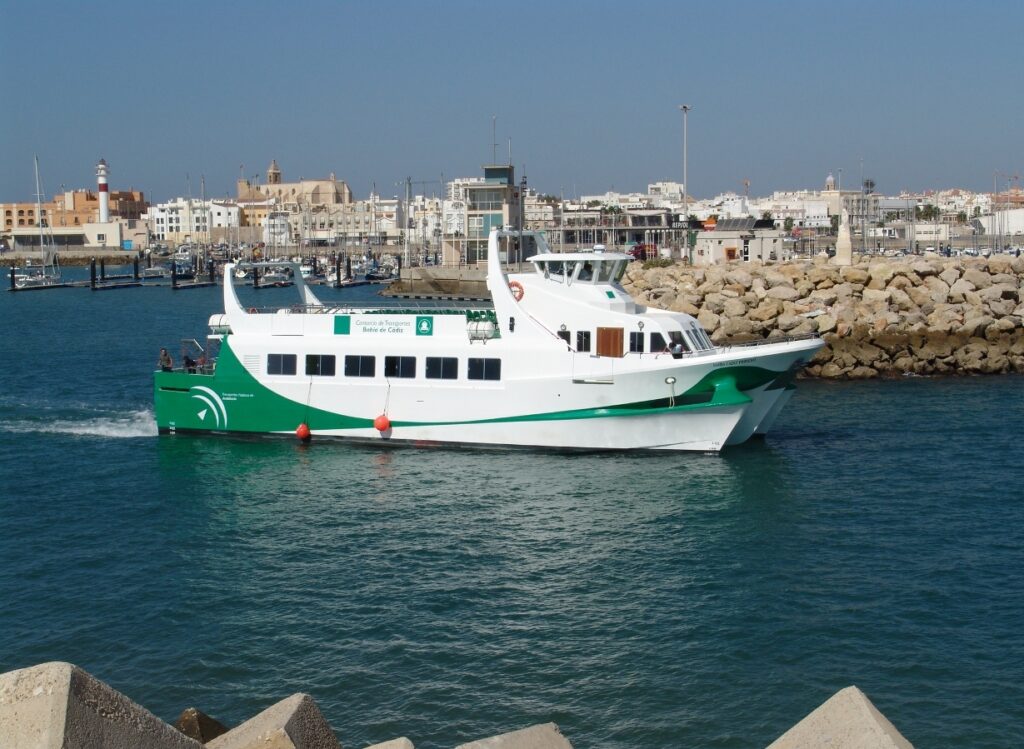
The vessels of the maritime service of the Metropolitan Transport Consortium of the Bay of Cádiz provide an efficient service
The maritime service began its journey with three vessels named “Bahía de Cádiz Primero,” “Bahía de Cádiz Segundo,” and “Bahía de Cádiz Tercero.” They are catamaran-type vessels made of polyester and fiberglass, 27 m long and 8 m wide, each with a capacity for 150 passengers and three crew members. They are powered by two 900-horsepower engines and can reach a maximum speed of 20 knots, although the service speed has been reduced to 14 knots to rationalize consumption and preserve the engines.
These vessels were built in 2005 at the Navantia shipyard in San Fernando (Cádiz). Due to the demand for the service, in 2009 the ship “Bahía de Cádiz Cuatro” was added, built at the Dalmau shipyard in Barcelona. Although similar in characteristics to the previous ones, it is somewhat more sophisticated and has better finishes. It is powered by two 1,100-horsepower engines, has bow thrusters for maneuvering, and the possibility of maneuvering from the bridge control fins.
All vessels and docks have boarding and accommodation facilities adapted for people with reduced mobility. Additionally, users can board with their bicycles and even with mopeds in a limited number. Passengers can make the crossing either inside the air-conditioned main deck lounge or enjoy the existing seats in the upper deck area in good weather.
We sense optimism in the words of technician José Luis Fernández Rioja when he tells us, “We hope that the demand for the service continues to grow, and therefore we can expand both the services and the fleet.” Undoubtedly, for the local population, it is a highly valued service, and for tourists and occasional visitors, an opportunity to stroll through the mentioned towns, where the traditional hospitality of the people of Cádiz, the region's gastronomy, and the renowned wines constitute a recognized calling card.
Photos: Juan Carlos Díaz Lorenzo and provided


Related posts
👁️ 21,386 

👁️ 2,839 

- by Juan Carlos Díaz Lorenzo
- 3 days ago
The ferry “Volcán de Tamasite”, renamed “Marhaba Seaways”
👁️ 1,075 
Most Recent
👁️ 1,075 
👁️ 2,577 
👁️ 17,790 