

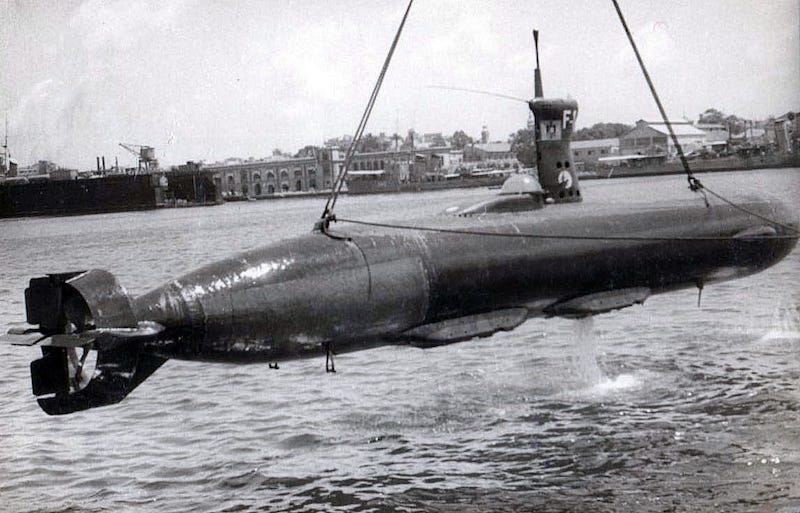
Remembering the Pocket Submarines “Foca 1” and “Foca 2”
Today I want to dedicate a few lines to the pair of "Foca" submarines that had a brief passage through the Spanish Navy, which does not prevent us from remembering them, as they say in my land, "the drum is also a troop".
After the collapse of Nazi Germany, several German technicians emigrated to seek their fortunes. Among a group of these highly regarded technicians was engineer Erich Vollbrecht, who settled in Cartagena and offered the possibility of manufacturing some of the so-called "pocket" submarines at the Bazán shipyard in Cartagena, based on the German "Seehund" project from the Third Reich.
Consequently, on December 31, 1952, an order was placed for the execution of a pair of units that would be named "Foca 1” and “Foca 2" (later SA-41 and SA-42). They displaced 17.8 tons on the surface and 21.3 tons submerged, and their keels were laid on November 28, 1953, for “Foca 1” and three days later for “Foca 2”.
Their construction was prolonged excessively, as the hardships of the time justified everything, since the first would not be launched until 1955, while the second had to wait until 1963. It is not possible to elaborate much in this medium, so I will only point out that in July 1969, both would be decommissioned from the Navy. Commanded by lieutenants, they were assigned a few non-commissioned officers and barely half a dozen corporals and/or replacement sailors for maintenance tasks on land, personnel who even wore their own Lepanto ribbon on their hats.
Although, as we say, their passage through the Navy was brief and truly without glory, they "were there", and they still are since the pair was saved from the cutting torch and today serve as garden ornaments. Apart from the aforementioned Lepanto ribbon, they had a pennant and even appeared on matchboxes from the Navy itself in the second half of the 1960s...
Another day we will remember their larger siblings, the "sharks", who had parallel lives, also of ephemeral existence and also saved from the destructive torch; today we will only remember the "Focas". As always, I hope this new installment of naval culture is to the liking of my readers.

Lepanto ribbon "Assault submarine"

Pennant of the submarine "Foca 1"
Photos: archive of Diego Quevedo Carmona
Tags


Related posts
👁️ 4,068 

- by Redacción
- 5 days ago
The Government Approves €2.196 Billion to Finance Three Naval Programs by Navantia
Most Recent
👁️ 444 
👁️ 3,371 
👁️ 19,754 