


The Maritime Life of the First 'Monte Urbasa' (1948-1969)
The history of shipbuilding and the Spanish merchant navy in the immediate post-war period includes the vessel 'Monte Urbasa', which flew the flag of Naviera Aznar 70 years ago. Now, a new generation tanker built at the Navantia shipyard in Puerto Real bears the same name and was delivered to its owner Ondimar Transportes Marítimos, a subsidiary of the Ibaizábal Group, on July 17.
The first 'Monte Urbasa' was the first of the type C project of the New Construction Plan of the National Company Elcano of the Merchant Navy; the so-called 'monasteries' series consisted of six ships, three of which were acquired by Naviera Aznar, two by Compañía Trasatlántica ('Covadonga' and 'Guadalupe'), and the last by Compañía Trasmediterránea ('Ciudad de Toledo').
The original project underwent modifications, hence the differences among the seven ships, among which our protagonist was part of the so-called U series of Naviera Aznar. In the case of the ship in question, it was originally a project contracted by the aforementioned shipping company, which later ceded it to Elcano and managed to recover it in 1947 after intense tensions with the INI chaired by Juan Antonio Suanzes.
Construction number 55 of the shipyard of the Spanish Shipbuilding Company, Sestao, where it began construction in January 1942, was launched on September 7, 1945, under the name 'Escorial' and entered service in April 1948, being assigned at its debut to the Vigo-South America line, with stops in Lisbon, Las Palmas, Montevideo, and Buenos Aires, while on the return trip it made a stop at the port of Santa Cruz de Tenerife.
The aforementioned line actually had its head in Genoa and included a stop in Barcelona, and also involved the ships 'Monte Udala', delivered in 1948; 'Monte Urquiola', in 1949; and 'Monte Ulía', in 1952. The series would be complemented by a late ship called 'Monte Umbe', inspired by the previous ones and more modern, which entered service in 1959.
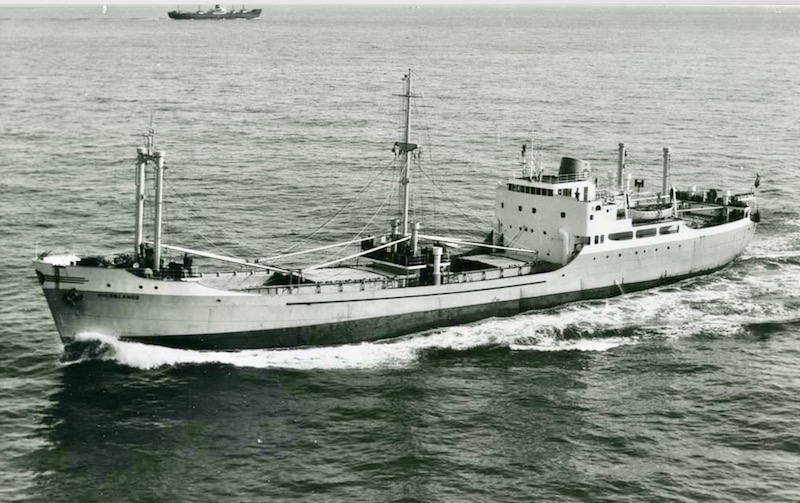
They were ships with an elegant and well-proportioned maritime line, a sharp bow and a cruiser stern, a continuous deck, 'shelter deck' type with two tween decks. Passengers and officers were accommodated in the central structure, while the subordinates were housed in the fore and aft accommodations. It was compartmentalized into six holds and had a good arrangement of supports – 18 in total – for loading and/or unloading operations. Among the innovations of the time, it had an air conditioning system supplied by the Swedish company Svenska Flakfabriken.
In November 1965, it suffered a collision in the waters of the San Lorenzo River with the Soviet merchant ship 'Kosmonos', resulting in various damages and one serious injury. In 1969, it was sold to Ybarra y Cía. and renamed 'Cabo Santa Paula' and sailed on the Plata line until its export in 1977, when it was sold to the Cypriot company Specova and renamed 'Esperos I'. In that same year, it was resold to the company of the same nationality, Riviera Navigation, and renamed 'Eurostar', and a year later, it passed into the ownership of the Lebanese owner A.H. Muktar and ended up being scrapped that same year in Yemen.
With a gross tonnage of 10,170 tons, net tonnage of 7,205 tons, and deadweight of 8,750 tons, it displaced 14,800 tons and measured 148.50 m in overall length – 139.34 m in length between perpendiculars – 18.92 m in beam, 12.10 m in depth, and 7.94 m in maximum draft. Registered in the naval registry of Bilbao, it had accommodation for 392 passengers and 71 crew members and was powered by a Sulzer engine, with 7,300 horsepower on a shaft, of Swiss manufacture, which allowed it to reach a speed of 17.5 knots in sea trials. IMO Code 5240760.

The ship 'Cabo Santa Paula', docked at the port of Genoa
Bibliography
Díaz Lorenzo, Juan Carlos (2004). Naviera Elcano Company. Six Decades of History. Madrid.
Valdaliso Gago, Jesús and Torres Goiri, Manuel (2012). One Hundred Fifty Anniversary (1861-2011). Ibaizábal Group. Bilbao.
Photos: PWR (shipspotting.com) and naviecapitani.it


Related posts


- by Juan Carlos Díaz Lorenzo
- 3 years ago
A Pescanova Project for Cuba Built in Mallorca
- by Juan Carlos Díaz Lorenzo
- 3 years ago
The Ship “Picoblanco” (1958-1981), Naval Registration of Bilbao

- by Juan Carlos Díaz Lorenzo
- 3 years ago
The Tanker Ship “Galdácano” (1961-1985), “the Acid Ship”
Most Recent
👁️ 1,376 
👁️ 3,935 
👁️ 949 