


Liquidity Issues for the Panama Canal Toll
Two of the “handymax” vessels from the Greek company Nordstrand Maritime & Trading, serving the maritime commercial interests of Cuba, named “Mariana” and "Manuela" and flagged in Panama, have been anchored for almost a month at the entrance of the Panama Canal, loaded with grain, waiting for the toll payment to cross to the Pacific. According to maritime media, the crew of the first vessel is owed several months of wages, and the second is also anchored nearby awaiting repairs after a fire in the engine room.
Both vessels are part of a batch of ten units whose contract was signed in September 2009 by the General Import Company of Transport (EIGT), on behalf of the Acemex Group, with the state-owned China National Machinery Import & Export Corporation (CMC). Although the terms of the contract have not been disclosed, it is estimated to be valued at 250 million dollars financed by Eximbank.
The order was assigned to the Shanghai Shipyard Co. Ltd., which resumed industrial activity after a year of drought. To save costs on the project, a production model was chosen, of which several have been built for other shipowners. The first of the new vessels was delivered in August 2011, named “Abdala.” The remaining nine have been named “Leonor,” “Manuela,” “Mariana,” “Celia,” “Haydée,” “Lidia,” “Gertrudis,” “Clodomira,” and “Josefa.”
Except for the first, which pays homage to the dramatic poem by José Martí published in January 1869 in “La Patria Libre,” and the second, named after Leonor Pérez Cabrera, born in 1828 in Santa Cruz de Tenerife and mother of the former, the others bear names of famous women in the history of the Cuban revolution.
These are multipurpose vessels of 22,400 gross tons, 12,800 net tons, and 34,900 deadweight tons, equipped with four 30-ton cranes to service five holds, with hulls measuring 180 m in length, 28 m in width, and 9.50 m in draft. Each is powered by a Burmeister & Wain engine, allowing it to maintain a speed of 12 knots. The typical crew consists of 22 people. The vessels have been classified by Lloyd’s Register and are in good condition. Ideally, maintenance should be adequate to ensure optimal operational performance.
The Cuban merchant marine, which for years was the most powerful in Latin America represented by the Mambisa Navigation Company and the Caribbean Navigation Company, suffered a serious setback starting in the 1990s. The contract signed with China is the most important recorded in recent years and will enable trade with Cuba's traditional partners, such as Iran, Angola, China, and Ecuador. In 1988, the aforementioned shipyard delivered to Cuba three other container ships named “Ernesto Che Guevara,” “Sierra Maestra,” and “Camilo Cienfuegos.”
Photo: twitter
Tags


Related posts
👁️ 729 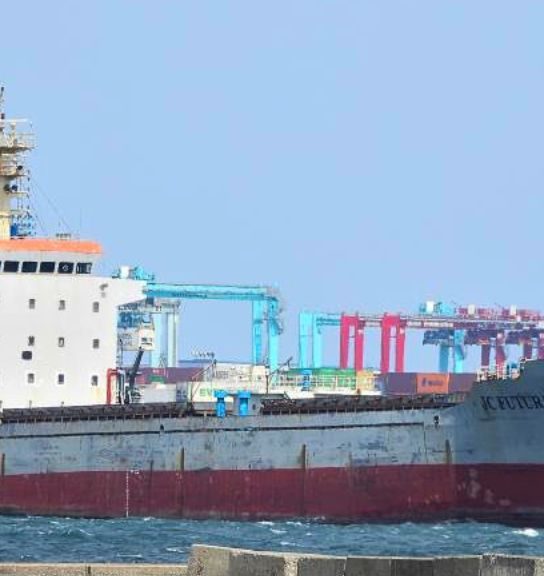

- by Redacción
- 2 days ago
Castellón Port Tests New Robotic Technology for Underwater Inspections
👁️ 11,190 
Most Recent
👁️ 4,080 
👁️ 5,456 
👁️ 4,832 