

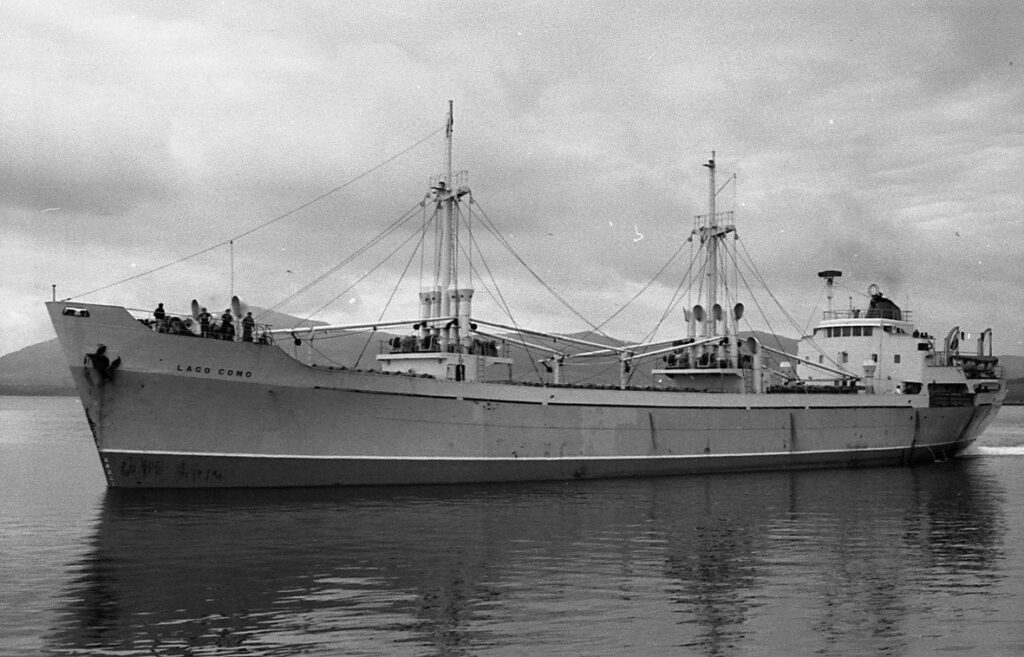
The Ship “Lago Como” (1960-1984), Naval Registration of Gijón
In May 1957, naval engineer Luis María Arroyo, representing Naviera Lagos, contracted with the shipyard S.A. Juliana Constructora Gijonesa for the construction of two general cargo ships, numbers 113 and 114 of the mentioned factory, which took shape simultaneously and slid down the slipway on March 1, 1960, and May 9 of the same year, named “Lago Como” and “Lago Garda” and registered in the naval registry of Gijón. The final armament was completed at the Euskalduna shipyard, where they were officially delivered in September and November 1960, respectively.
Upon delivery, the ship “Lago Garda” made its debut sailing to Northern Europe, carrying oranges on the way and wooden planks on the return. It also made several transatlantic trips, including one from Las Palmas de Gran Canaria to Guayaquil – with an intermediate stop in San Juan, Puerto Rico – carrying two railway engines, wagons, and piping. Subsequently, it covered the regular line between the Canary Islands and the ports of the Cantabrian Sea, on a round trip lasting 21 days, and also made some extraordinary trips to American ports.
In 1973, when it came under the control of Naviera Pinillos, it was transformed into a container ship at Astilleros del Atlántico, Santander, for which its supports and holds were removed and the deck was adapted for the transport of 91 TEUs, and it began to cover the Tenerife-Las Palmas-Alicante-Valencia line and later also sailed on the Canary Islands-Sevilla line.
In June 1981, it was moored in the port of Sevilla and after several months immobilized, it was finally sold for scrap in 1984. Its twin “Lago Garda,” which was in the same situation, was sold to Líneas Marítimas Hespérides to be dedicated to container traffic in the inter-island service of the Canary Islands and in 1985 was renamed “Isla de Fuerteventura.” In 1989 it was chartered to the company Oficus, which acquired it in 1990, renaming it “Ras Tina,” and for a time it sailed between Barcelona, Las Palmas, and the ports of Mauritania. In 1993 it came under the ownership of the company Flimex and finally, in April 2000, it was decommissioned and scrapped.
With a gross tonnage of 999 tons, net tonnage of 503 tons, and deadweight of 1,956 tons, it measured 80.68 m in overall length – 75 m in length between perpendiculars – 12 m in beam, 7 m in depth, and 4.47 m in maximum draft. Powered by a Burmeister & Wain engine, manufactured under license at the La Maquinista workshops in Barcelona, with a power of 2,016 horsepower, it reached a speed of 13.5 knots during sea trials.
Bibliography:
Díaz Lorenzo, Juan Carlos (1991). Naviera Pinillos 1840-1990. 150 years of maritime history. pp. 129-130. Santa Cruz de Tenerife
Photo: Teodoro Diedrich via Alberto Mantilla
Tags


Related posts


- by Juan Carlos Díaz Lorenzo
- 3 years ago
A Pescanova Project for Cuba Built in Mallorca
- by Juan Carlos Díaz Lorenzo
- 3 years ago
The Ship “Picoblanco” (1958-1981), Naval Registration of Bilbao

- by Juan Carlos Díaz Lorenzo
- 3 years ago
The Tanker Ship “Galdácano” (1961-1985), “the Acid Ship”
Most Recent
👁️ 3,828 
👁️ 5,165 
👁️ 4,580 