

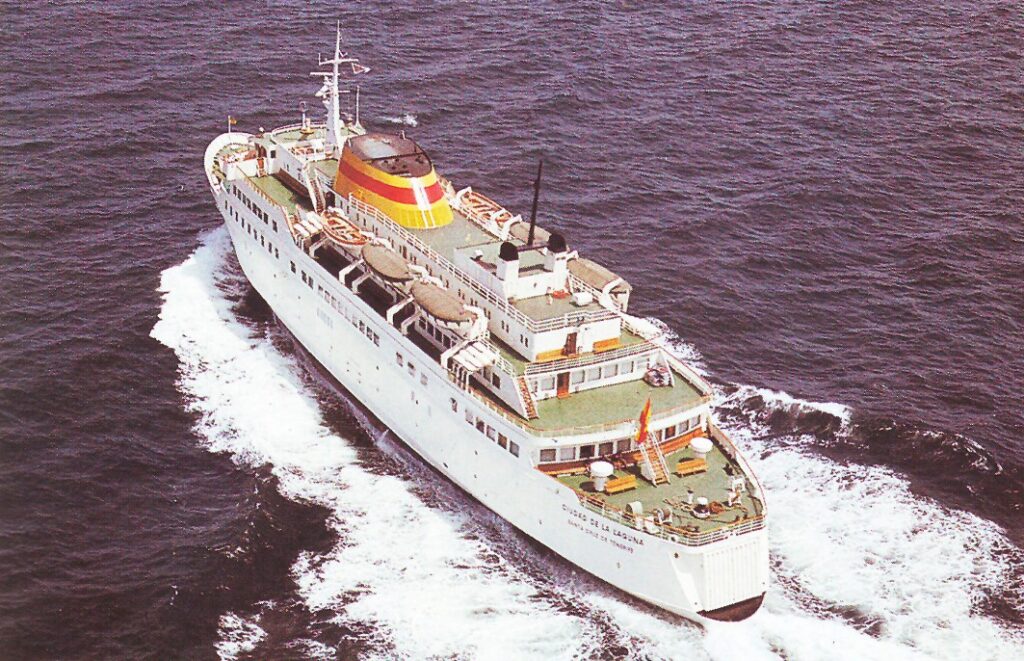
“Ciudad de La Laguna” (1975-1998), an exceptional ship
In the mid-1960s, considering both the needs of traffic between Finland and Sweden, as well as the success achieved by the ships "Skandia" and "Nordia", which had been in service since May 1961 and May 1962, the Finnish shipping group Silja Lines contracted with the Wärtsilä shipyard in Helsinki for the construction of two new ferries that would be named "Botnia" and "Floria", respectively.
Compared to their predecessors, in addition to some structural modifications, such as the removal of the cinema in the false chimney, the main difference was in their propulsion system, consisting of eight Wärtsilä 814 TK main engines, with a power of 8,520 horsepower, coupled in two groups of four to two lines of shafts and variable pitch propellers, and a cruising speed of 19 knots. It was equipped with four Wärtsilä auxiliary engines, of 368 kW, coincidentally, the pistons of the main engines had the same characteristics.
Weighing 3,514 gross tons, 1,183 net tons, and 1,240 deadweight, it measured 101.61 m in overall length – 92.82 m between perpendiculars – 18.67 m in beam, 11.66 m in depth, and 4.91 m in maximum draft. It had capacity for 162 passengers in berths and 880 in seats, as well as a garage for 380 linear meters and a car deck for 195 cars.
The construction of the ship "Botnia" began in 1966, being the construction number 384 of the mentioned shipyard. On March 2, 1967, it slid down the slipway, with Mrs. Disan von Rettig acting as godmother, and on October 30 of that same year, it was delivered to its owners, the aforementioned company Silja Lines, entering service that same day on the Turku-Mariehamn/Langnäs-Stockholm route and alternating on the Turku-Mariehamn/Langnäs-Norrtälje route.
One year after entering service, on November 28, 1968, it suffered its first major incident due to a collision with the ferry "Ilmatar" while maneuvering near the port of Langnäs. The accident resulted in three deaths and seven serious injuries, one of whom later died in the Marienhamn hospital.
The ferry "Botnia" was ordered to proceed to the port of Langnäs, where it unloaded the vehicles it was carrying. Its sister ship "Nordia" took care of transporting the passengers to the port of Norrtälje, while the ferry "Holmia" transferred the cargo to Stockholm. An error in interpreting the maneuver caused the accident, according to the commission of inquiry. The repair of the damages took two weeks, and during that time it was replaced in service by the ferry "Nordia", of the same company.
In April 1970, it passed to the ownership of the company Anfartygs Bore Ltd., based in Turku and also belonging to the Silja Lines shipping group, formed by the companies Bore, Finska Line, and Svea Line. The ferry "Botnia" continued to operate on the same route, and on August 22, 1972, it suffered another significant incident, colliding with the port of Langnäs under adverse weather conditions, with a storm of force eight.

Model of the ship "Botnia" at the Silja Lines headquarters
In the mid-1970s, Compañía Trasmediterránea needed to renew the inter-island services in the Canary Islands and commissioned Captain Tomás Ravelo and Chief Engineer Pascual Marín to travel to Finland to evaluate the characteristics of two ships that would be suitable for sailing in the waters of the Canary archipelago. The mentioned officers focused their attention on the ships "Botnia", "Floria", and "Viking 1", and after a thorough inspection, the choice of the first two ships was made, finalizing the decision to purchase, at which point an inventory was carried out.
The operation was formalized on March 22, 1975, and the ferry "Botnia" was acquired for a price of 22,385,000 Finnish marks. Subsequently, the mentioned ship ceased its itineraries with Silja Lines and set sail for Rauma, where it entered dry dock for a technical inspection. The Spanish government's council of ministers, chaired by Carlos Arias Navarro, authorized the procedures for its importation in its meeting on May 7 of that year, in accordance with the provisions of Article 5 of the Law of May 12, 1956, and what was stipulated in the Canary Islands REF law, with an exception, since the ship to be imported exceeded the established limit.
Back afloat, on June 2, the flag and name change to "Ciudad de La Laguna" was carried out – Captain, Tomás Ravelo García – and it underwent sea trials prior to delivery. Two days later, it traveled to Helsinki, where the purchase-sale deed was signed in the presence of the Spanish diplomatic representation, one of whose clauses included the construction of six multipurpose ships in Spain. The name of this ship and that of "Villa de Agaete" was due to an initiative from the then president of the Insular Council of Gran Canaria, Lorenzo Olarte Cullen.
On June 9, it set sail for Cádiz, and two days later, when it was navigating the Kiel Canal, it was struck in a false maneuver by the Icelandic merchant ship "Hvalvik", resulting in the ship "Ciudad de La Laguna" sustaining serious damage to the starboard bow, which forced it to make an emergency stop in Kiel to repair the damage at the Howaldtswerke shipyard. The bow was rebuilt, and after inspection by Lloyd's, on June 11, it continued its journey to Cádiz.
After the collision, Captain Ravelo filed a damage protest through the Spanish diplomatic representation in Hamburg. In the end, after a lengthy process, the ruling was favorable to the captain of the ship "Ciudad de La Laguna", with the insurance covering not only the damages incurred but also the economic losses that the ship's downtime in the Kiel shipyard had caused.
On July 14, it arrived at the port of Cádiz to conduct the official sea trials in the presence of Spanish Navy authorities. Five days later, it set sail again, heading for Santa Cruz de Tenerife, and on the 21st, shortly after noon, it arrived for the first time at the Tenerife port, amid considerable anticipation, as the local press had been reporting on the matter for days. On July 29, it entered service, establishing the maritime bridge between Las Palmas and Santa Cruz de Tenerife. On its first trip, it transported 149 passengers and 25 cars.
By order of the Ministry of Commerce on October 20, 1975, the flagging and registration in Santa Cruz de Tenerife was authorized, with the limitation of its navigation in the inter-island services of the Canary Islands.
Between December 1975 and January 1976, the ferry "Ciudad de La Laguna" participated in the evacuation of the Sahara, making five trips to Villa Cisneros to evacuate personnel and material. It also had a notable performance when one day after the accident of the two “jumbos” of KLM and Pan Am at Los Rodeos airport, on March 28, 1977, it made four daily trips for eleven days to maintain communication between the two Canary capitals. Its crew was awarded the Naval Merit Cross with a white distinction for their extraordinary services.
From 1979, with the installation of mobile ramps and heels in the ports of the smaller islands, as well as the commissioning of the new “jet-foil” between the two Canary capitals, the ferry "Ciudad de La Laguna" – like its nearly identical twin "Villa de Agaete" – began a radial service to each of the mentioned islands, rotating both weekly between the eastern and western lines. In 1979, stops in Arrecife and Puerto del Rosario were inaugurated, and the following year, when the new mobile ramps were installed, the service was expanded to the islands of La Palma, La Gomera, and El Hierro.
On June 29, 1985, on the occasion of the inauguration of the astrophysical complex of Roque de Los Muchachos, on the island of La Palma, with the presence of the Kings of Spain and other European monarchs and heads of state, three units of Compañía Trasmediterránea, equipped as floating hotels and logistical support centers for the grand event, coincided at the port of Santa Cruz de La Palma. The ships "Ciudad de La Laguna", "Villa de Agaete", and "Manuel Soto" occupied the main dock, in a unique occasion.
In that same year, on November 13 – Captain, Francisco Santiago Nebreda – it embarked the III Flag of the Legion in Puerto Rosario, with all its equipment and material for transfer to Málaga. From the capital of Fuerteventura, it set sail at noon and arrived at the Málaga port in the afternoon of the 15th, proceeding that same night back to Las Palmas to rejoin its regular service.
In June 1987, taking advantage of the annual dry dock at ASTICAN, 300 new airplane-type seats were installed in the spaces that had until then occupied the dining room, game room, and disco. This circumstance was decisive for its placement on the Málaga-Melilla line, after obtaining authorization from the General Directorate of Merchant Marine in December 1988.
In June 1992, it was definitively withdrawn from the services of the Canary Islands and since then covered the Valencia-Ibiza, Málaga-Melilla-Almería, Algeciras-Ceuta lines and replaced the ferry Villa de Agaete on the Los Cristianos-La Gomera-El Hierro line due to the annual regulatory dry docks.
In 1994, to better meet the demand for road traffic, a work was carried out that allowed an increase of 20 centimeters in the free height in the garage. During 1996 and 1997, and in accordance with the 1995 amendments to SOLAS and to meet its requirements, an interior watertight door was installed at the stern of the existing bow ramp, and the fire detection and fighting equipment, special low-height lighting and emergency lighting, as well as communications and other applicable requirements were improved and expanded.

In its third stage, renamed "Volcán de Tenagua"
In October 1998, the ferry "Ciudad de La Laguna" was acquired by Naviera Armas with the intention of converting it into a cruise ship for short tourist trips. The ship was moored in Algeciras and from there it set sail for Santander to undergo a remodeling of its facilities. The refurbishment work was carried out at the Santander shipyards and was completed in February 1999.
Starting in April, renamed "Volcán de Tenagua", it was operated by Armas Cruceros. The remodeling of the ship, which cost 600 million pesetas, was carried out by the company Oliver Design from Bilbao. One of the most significant aspects was the extension of the boat deck to accommodate a pool and a solarium with loungers for about 200 passengers.
On May 30, Canary Islands Day, it made its first round trip to the island of La Palma, achieving notable success, and on June 18, it made its first round trip to Lanzarote, a type of short cruise that allowed discovering new landscapes and sensations of the beauties seen from the sea and aboard a ship specially prepared for such activities.
Later, when Trasmediterránea withdrew from the inter-island lines of the Canary Islands, which affected, among others, the Los Cristianos-La Gomera-El Hierro line, with the sale of the ferry "Isla de La Gomera", the service was taken over by Naviera Armas, assigning the ship "Volcán de Tenagua" for it. The premiere could not have been more disappointing. A series of technical failures hampered the start of operations, forcing the suspension of the service and the dry docking of the ship at ASTICAN for the tuning of its engines. After this “premiere,” normalcy returned.
In 2007, Naviera Armas aimed to establish a line connecting the Canary archipelago with Morocco by creating the Las Palmas-Puerto del Rosario-Tarfaya line. To this end, it refurbished the ship "Volcán de Tenagua" at the Izar shipyard in Ferrol, being flagged in June of that year in Panama and renamed "Assalama".
The main problem that the establishment of the line faced was the declaration of Schengen port (recognition as a border post by Spain and the European Union) in Fuerteventura, leading to speculation initially that it would be Arrecife de Lanzarote, which did have this status, as the starting point for the Naviera Armas ship. However, the declaration as an external border arrived in October, clearing up doubts and allowing the ferry "Assalama" to depart on December 10 of that year from Puerto del Rosario on its journey to Tarfaya, carrying on its first trip 56 vehicles and 162 passengers, mostly of Moroccan nationality. The official inaugural trip took place on January 12, 2008.
Naviera Armas could not maintain this line for long, as on April 30, 2008, while departing from the port of Tarfaya bound for Puerto del Rosario, with 114 passengers on board, the ship suffered a serious incident that led to its definitive loss.

Condition of the ship "Assalama", in May 2017
During the departure maneuver, due to the strong wind and rough seas prevailing, it struck the hull against the dock. The ship continued its course, but the rubbing had caused a water ingress that forced it to return to Tarfaya, which it could not do because the ship began to list dangerously about three miles from the coast. An hour after leaving the port of Tarfaya, around noon, the evacuation of the passengers was carried out using the lifeboats of the ship itself and assisted by local fishermen.
The attempt to rescue the ship was carried out with the support of a Moroccan tugboat and a team of divers. The tugboat tried to keep the vessel afloat during the salvage operation, while the divers faced serious difficulties, but the unexpected listing of the ship complicated the rescue efforts, so that the entire crew had to be evacuated to shore. The ship ran aground in shallow waters and was considered definitively lost. Currently, it remains in the same condition suffering severe deterioration.
Bibliography:
Díaz Lorenzo, Juan Carlos. One hundred years of inter-island steamers in the Canary Islands. Santa Cruz de Tenerife, 1989.
Díaz Lorenzo, Juan Carlos. Sheltered from Anaga. Two volumes. From the small ferries to the fast ferry (vol. I) and From the sea and the ships (vol. II). Madrid, 2004.
Photos: Archive of Laureano García Fuentes, Silja Lines, Kenneth Karsten, and Juan Carlos Acosta


Related posts


- by Juan Carlos Díaz Lorenzo
- 3 years ago
“Villa de Bilbao” (1962-1981), naval registration of Valencia
- by Juan Carlos Díaz Lorenzo
- 3 years ago
The Maritime Life of the Roll-on Ship “Cala Llonga” (1972-1999)
👁️ 235 
- by Juan Carlos Díaz Lorenzo
- 3 years ago
The iconic ferry “Juan J. Sister” celebrates thirty years
Most Recent
👁️ 1,077 
👁️ 2,579 
👁️ 17,806 