


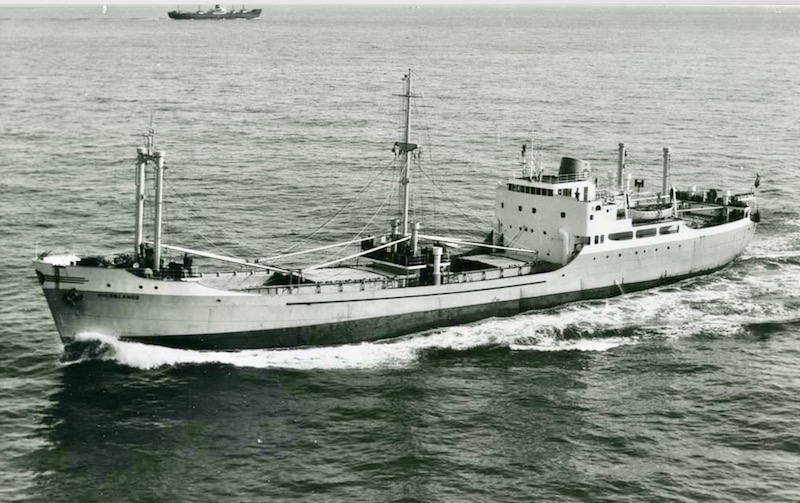
"Butanueve" (1969-1973), the largest ship in the Butano fleet
In 1965, the naval division of the Butano company appeared on the scene of the Spanish merchant navy with four newly built ships, named “Butauno”, “Butadós”, “Butatrés” and “Butacuatro”, constructed in pairs at the shipyards of Matagorda and Euskalduna. The first two were assigned to the shipyard of the Spanish Shipbuilding Company in Matagorda, Cádiz, as they were to be the first, and the next two to Euskalduna, although the roles were reversed as the Basques got ahead of the Gaditans, so the last two were the first to enter service.
Four more ships were subsequently transformed at the Tomás Ruiz de Velasco shipyard, based on the adaptation of general cargo ships named “Navafría”, “Navalhorno”, “Río Hijuela” and “Tomás Ruiz de Velasco”, which were renamed “Butacinco”, “Butaséis”, “Butasiete” and “Butaocho”, respectively. Butano also had six other Spanish ships chartered for its service: “Vinci”, “Newton”, “Ine”, "Cibeles" (later "Isla de Mouro"), “Isla de Marnay” and “Tamames”.
In the midst of Butano's expansion, in line with the increase in demand for liquefied petroleum gases in the Spanish market (mainly propane), the company decided to build the ninth ship in its fleet, which would be the largest of the eleven it had during its existence. It was a ship designed for transatlantic gas transport, primarily intended for propane loads at -48ºC.
Commissioned to the shipyard of the National Company Elcano, Sevilla, its launching took place on March 30, 1968, with Miss María Teresa González Sampedro serving as godmother, and it entered service in 1969 –captained by Alfonso de Campos Setién–, shortly after the birth of the Spanish Shipyards Society (AESA), the giant of Spanish shipbuilding that competed, alongside ASTANO, in the international market. It is worth noting that it was the only ship of its kind built at the Seville shipyard and was advised by French technicians.
Weighing 10,909 gross tons and 11,255 deadweight tons, it measured 153.30 m in overall length, 21.10 m in beam, 12.35 m in depth, and 8.50 m in draft. It had a capacity for 13,800 cubic meters of cargo in four tanks and was powered by a Sulzer 6RD76 diesel engine, with 9,600 horsepower on a shaft, allowing it to maintain a speed of 16 knots. IMO Code 6813215.
This ship had a brief stint in the Butano fleet, as it was sold in 1973, just four years after its incorporation. Renamed “Gambhira” and operated by British interests, it was resold to Norway in 1986 and until 1991 bore the name “Havpil”. Then came a three-year period under the name “Lulligas” and in 1994 it was renamed “Kapitán Luca”, being decommissioned just two years later, as in November 1996 it began its dismantling in Alang (India).
Photo: archive of Alberto Mantilla Pérez
Tags


Related posts


- by Juan Carlos Díaz Lorenzo
- 3 years ago
A Pescanova Project for Cuba Built in Mallorca
- by Juan Carlos Díaz Lorenzo
- 3 years ago
The Ship “Picoblanco” (1958-1981), Naval Registration of Bilbao

- by Juan Carlos Díaz Lorenzo
- 3 years ago
The Tanker Ship “Galdácano” (1961-1985), “the Acid Ship”
Most Recent
👁️ 4,401 
👁️ 5,757 
👁️ 5,124 