

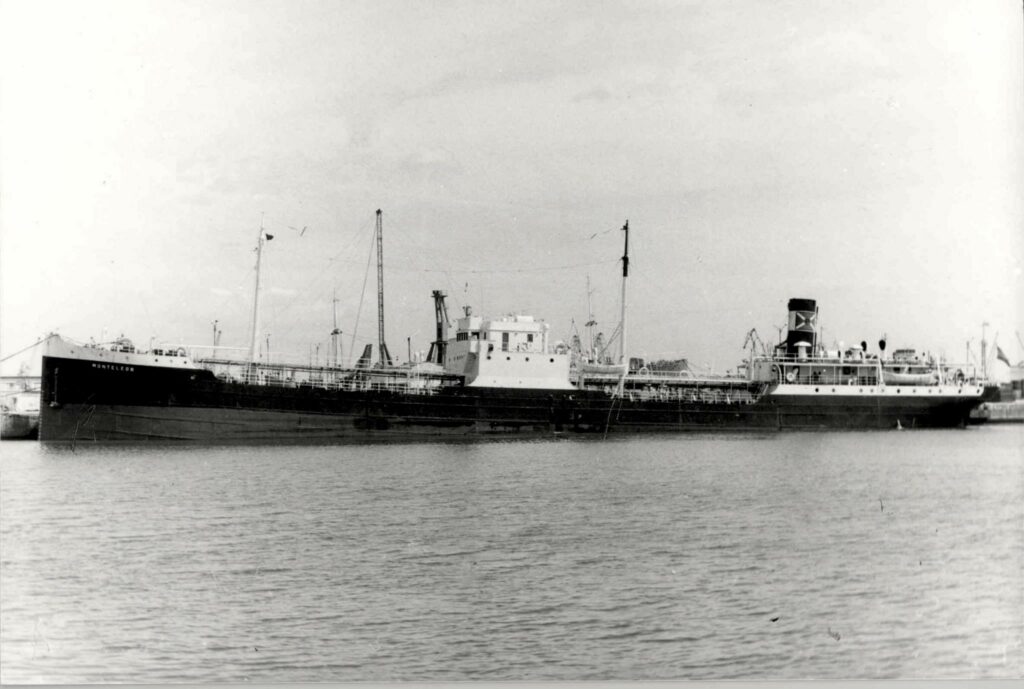
50 Years Since the Tragedy of the Oil Tanker 'Monteleón'
For several years, the first "Monteleón" from CEPSA held the honorable title of being the oldest oil tanker in active service in the world.[1] On March 19, 1966, the feast day of Saint Joseph, the ship was docked at the Hondura pier in the port of Santa Cruz de Tenerife, having arrived from Tarragona, and the service personnel were preparing tanks to receive a cargo of asphalt. The crew numbered thirty, but most of them, due to the holiday, were on land enjoying time with their families, as most were residents of the island.
Shortly after connecting hoses and at the moment of starting the loading, suddenly, a sudden explosion, followed by a violent fire, claimed the lives of the group that was working on deck and at the Hondura pier at that moment. The two fatalities that the accident claimed in the first moments became a total of seven over the hours, as five of them did not survive the severe burns suffered.
The deceased were: Jesús López Iglesias (second officer), Carlos Florencio Santurino (radio telegrapher), Antonio Alberto Fraga Castro (cook), Juan Fernández Álvarez (galley boy), Feliciano Olveira Crujiera (sailor), Ramón Marrero Díaz (steward) and Manuel Herrera Rodríguez (dock sailor at La Hondura). Today marks 50 years since their tragic passing. Our thoughts are with them, as well as with the seriously injured, Pedro Gurriana, José González Benítez, Juan García Rodríguez, Víctor Sosa Hernández, and Feliciano Almeida.

Firefighters fight the fire aboard the 'Monteleón'

The oil tanker 'Monteleón', with the burned bridge, anchored off Santa Cruz de Tenerife
Firefighters from the refinery and the capital of Tenerife, as well as civil and military authorities, CEPSA executives, and many land colleagues and crew members from the fleet residing in the city, responded to the distress call in a spontaneous and humanitarian act, arriving at the scene of the disaster to offer their help in the face of the impressive situation. An eyewitness stated that at the moment of the explosion, the oil tanker was violently shaken, lifted above the water, and the fire spread immediately from bow to stern.[2] The Spanish oil tanker "José Calvo Sotelo" was docked at the duques de alba, which managed to start its engine and move away from the infernal scene.
When the fire was finally brought under control, the anachronistic maritime image of the veteran "Monteleón" showed the scars of the tragedy. The tugs "CEPSA" and "CEPSA Segundo" that came to its aid pulled it away from the dock, and for several days it remained anchored in the outer harbor until CEPSA decided to take it to the Peninsula and sell it for scrap. Thus, “under a black pall of smoke,” in the words of maritime journalist and naval historian Juan Antonio Padrón Albornoz, the old "Monteleón" left the sea forever, framed in an anachronistic image: straight bow and mirror stern, with tall masts in flames to the sound of the chimney, on a hull with little dead work and 66 years of maritime history on its frames.
"Tiflis". A Historic Ship
Construction number 704 from the historic shipyard Armstrong & Whitworth in Newcastle slid down the slipway on June 22, 1900, and in September it set sail named "Tiflis", under the Belgian flag and the password of the shipping company S.A. Pour L’ Importation des Huiles de Graissage, based in Antwerp. A year later, the owning company merged with other Belgian companies also interested in the transport of crude and derivatives. Thus, the S.A. d'Armement, d'Industrie et de Comerce was founded, also based in Antwerp, to which the "Tiflis" passed along with the rest of Ch. Good's fleet.
In 1914, after the breakdown of European peace, Belgium saw its borders violated and its neutrality breached, but the oil tanker "Tiflis" continued its voyages managed by one of the several subsidiaries its owners had in London and Paris. On March 3, 1915, when the ship was maneuvering out of the port of Alicante after unloading 1,400 tons of fuel for the deposits of the Sociedad Deutsch y Cía., a violent explosion occurred in the fore tank followed by a spectacular fire.
One day later, two new explosions occurred, and when the flames were finally extinguished after great efforts, four crew members were missing from a total of thirty, including one Spaniard and one Argentine. Captain Charles Zystor attempted to take the ship out of the bay and beach it on a nearby shore, but the intensity of the fire made it impossible.[3] Despite the severe damage suffered, the ship was temporarily repaired in the Alicante port and then headed to England, where the repairs were completed.

The oil tanker 'Tiflis', in dry dock at Matagorda
In 1916, the official ownership of the oil tanker "Tiflis" passed to the Tiflis Steamship Co. Ltd. –it is possible that the ship was owned by Echevarrieta and Larrinaga and was chartered to the aforementioned company– and a year later it began to fly the password of Lane & MacAndrew Ltd. and T.W. Taplin & Co. Ltd., based in London. Both shipping companies were responsible for the numerous oil tankers chartered to provide auxiliary services to the Royal Navy. As José Luis Gutiérrez Molina notes, “during the war, they had already bought an oil tanker that they could not use as it was seized by the British government to supply their ships in the Black Sea”.[4]
During the war, the oil tanker "Tiflis" mounted a 76 mm. piece at the stern and remained operational as a supply ship for fueling surface and submerged vessels of the Royal Navy present in the aforementioned area. When the conflict ended, the ship was repaired at the Echevarrieta and Larrinaga shipyard in Cádiz, at the expense of the British government, and in 1920 began its history under the Spanish flag, when the oil tanker officially passed to the ownership of the aforementioned industrialist and in that same year to the Compañía Vasco-Valenciana de Navegación, based in Bilbao, being chartered to the Sociedad Petrolífera Española.
In the entry movement of ships to the port of Barcelona in November 1930, there is a mention of the steamer "Tiflis", “from Batoum, with oil”.[5] In August 1934, the ship passed to the ownership of CAMPSA –captain, Carlos Miguel Zubillaga–, who acquired it for just over 200,000 pesetas. Of its fleet companions, the ships "Ebros" and "Eduardo" were converted into oil barges. In that year, its name disappeared from Lloyd's Register, and from then on it took on the humble role of oil barge.
At the beginning of the Spanish Civil War, the oil tanker "Tiflis" was moored in the port of Vigo, and its rehabilitation was ordered to return to service, and in October 1939 it made its first journey without escort to the Santa Cruz de Tenerife refinery, “recruiting its officers and most of the crew from CAMPSA sailors”.[6] It also acted as a supply barge in the waters of Mallorca and participated in various national supply convoys.
"Campestre"
At the end of 1940, with the world at war again, the oil tanker "Tiflis" was towed to the Unión Naval de Levante shipyard. On May 15, 1941, work began to prepare it for long-distance voyages, finishing the work on April 13, 1943. The shipyard's records state that “the need for oil tankers forced CAMPSA to order the refurbishment of its old steamer "Tiflis" (now "Campestre"), to cover the direct line with factories in North America and Venezuela. Great difficulties had to be overcome, and considerable work was done; coal was replaced with fuel oil, and with a new propeller, speeds unknown to this ship were achieved”.[7]
That oil barge had taken on a new maritime appearance and with the new name "Campestre" –captain, Alfredo Palazuelos Morante– it returned to sail under the CAMPSA password. Despite its limited tank capacity, it proved to be a valuable help during World War II, as it crossed the Atlantic repeatedly in search of Venezuelan crude. It then had its hull painted with national colors on the sides and fins, and its name and nationality in large white letters halfway along its length.

The oil tanker 'Campestre', during sea trials after its reconstruction
But it was not only Spain that benefited from the services of the veteran oil tanker. Until the end of 1945, together with other Spanish ships, it made voyages on behalf of the Portuguese Institute of Fuels (IPC). When the war ended, and unnecessary for long-distance services, the oil tanker "Campestre" was relegated to coastal cabotage, with some sporadic trips to the Tenerife refinery. At the beginning of 1948, on January 4, it ran aground in Bonanza, although it was later refloated without any significant damage.[8]
At that time, it was a ship of 3,030 gross tons, 1,067 net tons, and 4,433 deadweight tons, with a hull of 96 m in total length –92.45 m between perpendiculars–, 12.19 m in beam, 7.64 m in depth, and 6.25 m in draft. It was powered by a triple expansion steam engine, manufactured in the workshops of Wallsend Slipway Co., which took steam from two Scottish return flame boilers and developed a power of 1,400 horsepower on a shaft, reaching a speed of 10 knots in good weather.
"Monteleón"
Then came a new phase of mooring, and in 1958 it was purchased by CEPSA for 216,208 pesetas, with the aim of adapting it for the transport of asphalt emulsions, thus becoming the first asphalt ship in the country, with the Unión Naval de Levante shipyard taking care of its adaptation for that purpose. The first captain of this new phase was Ricardo Dulanto Unceta and Domingo ‘Txomin’ Legarza Iturraspe, its first chief engineer. Renamed "Monteleón", it retained its Cádiz registration and from then on became a frequent visitor to the port of Tenerife. However, when it was already being considered for replacement by a more modern unit, the fatal explosion of March 19, 1966, occurred, marking the abrupt end of its maritime life.
The fate of the veteran "Monteleón" was sealed. Escorted by the oil tanker "Ciudad Rodrigo", it set sail for Cádiz, and in its last voyages, it was powered by the old steam engine and was steered with the rudder located at the stern. On May 21, it anchored in the waters of the Cádiz bay, where the boilers, pumps, and other usable elements were dismantled, and then towed to the port of Gijón, where it arrived on September 1, and the ship was handed over to the scrap dealers of Avilés who cut it up.[9] And when that happened, the oldest oil tanker in the world disappeared.
Notes:
[1] At that time, there was the Mexican oil tanker San Luciano, from the Compañía del Boleo, which, although it was only a couple of years newer, had first been built as a freighter and years later its holds were replaced by cylindrical tanks.
[2] El Día, March 20, 1966.
[3] Details of the tragic event can be extensively consulted in Vicente Sanahuja's article titled “The Fire of the Tiflis,” published on December 27, 2009, on his website www.vidamaritima.com, as well as the article titled “The Horrendous Explosion that Marked a History,” by Juan José Amores, on the website www.alicantevivo.org.
[4] Gutiérrez Molina, José Luis. Basque Capital and Andalusian Industry. The Echevarrieta and Larrinaga Shipyard in Cádiz (1917-1952). p 118. Cádiz.
[5] La Vanguardia, November 15, 1930.
[6] Martínez Gil, Alfonso. Fiftieth Anniversary of the Fleet of the Oil Monopoly 1927-1977, p. 28. Madrid, 1977.
[7] Janini, Álvaro (director bookseller). Unión Naval de Levante, S.A. Commemoration of the 25th anniversary of its foundation. p. 149. Valencia, 1949.
[8] Díaz Lorenzo, Juan Carlos. Scale in the Atlantic. The Port of Tenerife and the CEPSA Refinery. p. 243. Santa Cruz de Tenerife, 2006.
[9] Díaz Lorenzo, Juan Carlos. Naval Gray in the Spanish Merchant Navy. pp. 444. Santa Cruz de Tenerife, 2013.
Bibliography
Amores, Juan José. The Horrendous Explosion that Marked a History. In www.alicantevivo.org.
Díaz Lorenzo, Juan Carlos. Scale in the Atlantic. The Port of Tenerife and the CEPSA Refinery. Santa Cruz de Tenerife, 2006.
Díaz Lorenzo, Juan Carlos. Naval Gray in the Spanish Merchant Navy. Santa Cruz de Tenerife, 2013.
Gutiérrez Molina, José Luis. Basque Capital and Andalusian Industry. The Echevarrieta and Larrinaga Shipyard in Cádiz (1917-1952). Cádiz.
Janini, Álvaro (director bookseller). Unión Naval de Levante, S.A. Commemoration of the 25th anniversary of its foundation. Valencia, 1949.
Martínez Gil, Alfonso. Fiftieth Anniversary of the Fleet of the Oil Monopoly 1927-1977. Madrid, 1977.
Sanahuja, Vicente. The Fire of the Tiflis. On www.vidamaritima.com.
Photos: Archive of Juan Carlos Díaz Lorenzo and Juan Antonio Padrón Albornoz (University of La Laguna)


Related posts

- by Juan Carlos Díaz Lorenzo
- 3 years ago
When the catamaran “Virgen del Valle II” passed through Tenerife (2013)

- by Juan Carlos Díaz Lorenzo
- 3 years ago
The Civil Guard Celebrates Four Emblematic Anniversaries

- by Juan Carlos Díaz Lorenzo
- 3 years ago
The Oil Tanker “Gerona” (1975-1988), a Milestone for CEPSA
Most Recent
👁️ 3,821 
👁️ 5,154 
👁️ 4,568 