

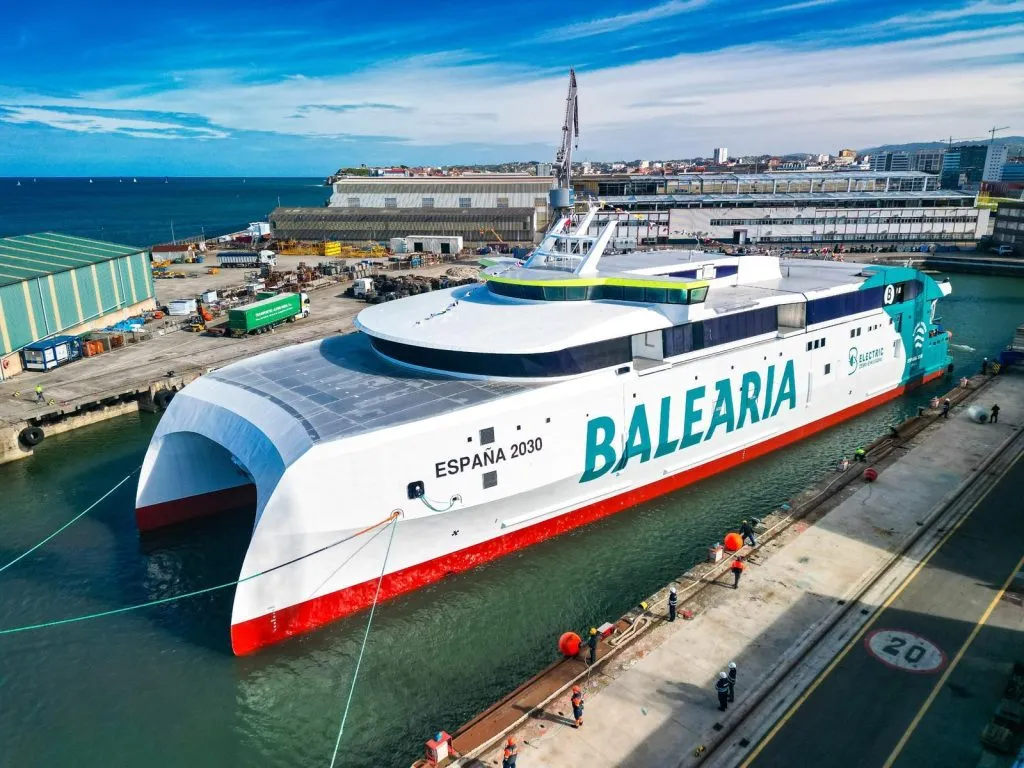
The 100% Electric Fast Ferry “España 2030” to Fly the Spanish Flag and be Registered in Santa Cruz de Tenerife
The new 100% electric fast ferry “España 2030” will fly the Spanish flag and be registered in the naval registry of Santa Cruz de Tenerife, according to sources from Baleària. The expectation is that the innovative vessel will be delivered in June 2027, and before its incorporation into the Tarifa-Tanger Ville line, it may come to the Canary Islands for a presentation on the San Sebastián de La Gomera-Los Cristianos line, as expressed by Adolfo Utor, responding to the interest of the president of the Cabildo of La Gomera, Casimiro Curbelo, regarding the decarbonization process of maritime transport.
Both the investment in the construction of this vessel and its twin, as well as the electrification of the ports of Tarifa and Tanger Ville, are fully covered by Baleària. Both units will have four diesel generators of 10,000 kW power to ensure their operability in any contingency.
Additionally, both its construction and certification are strictly subject to the parameters required by international agreements and the Spanish Maritime Administration.
Built at Astilleros Armón Gijón and launched at high tide on October 24, it follows three larger siblings powered by liquefied natural gas —“Eleanor Roosevelt”, “Margarita Salas” and “Mercedes Pinto”— and represents a milestone in the history of Spanish shipbuilding regarding Australian project vessels and high-speed ships.
“Baleària maintains a strong commitment to the Spanish shipbuilding industry, with six new vessels ordered from national shipyards in the last five years, actively contributing to the generation of industrial employment and economic activity in the country,” the company highlights.
This strategic project, with a cost of over 200 million euros, includes the construction of two electric vessels and the electrification of the ports of Tarifa and Tanger Ville. The catamarans will be equipped with OPS systems and state-of-the-art batteries capable of completing the entire journey of 18 nautical miles exclusively with electric propulsion and without generating emissions, noise, or vibrations.
The new vessels will connect in the ports through two fully automated robotic arms for electrical connection capable of supplying up to 16 MW of electricity, a fast charging system that will allow the vessels to recharge in just 40 minutes.
Photo: provided
Tags

Related posts
👁️ 35,673 

👁️ 851 

Most Recent
👁️ 598 
👁️ 4,028 
👁️ 35,673 